Kanbayashi Onsen
Near Yamanouchi (Yudanaka), Nagano Prefecture, Japan
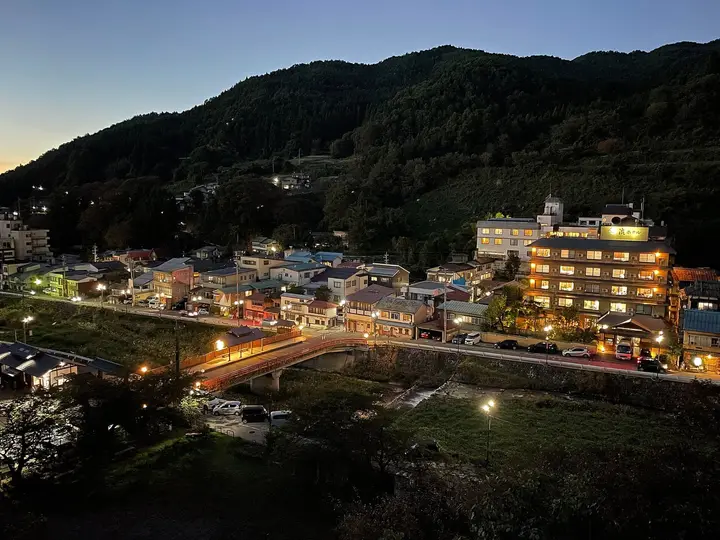
A quiet four-inn hot spring village in the forest at the foot of Shiga Kogen, fed by water piped from Jigokudani and a 1.6 km walk from the snow monkey park.
- Water temperature
- Not published
- Entry
- Paid
- Getting in
- Drive-up
- Type
- Resort or spa
- The nearest hot spring village to Jigokudani Monkey Park, about 1.6 km (1 mile) or 25 to 30 minutes on foot.
- Just four inns, three of them dating from the Meiji, Taisho and early Showa eras, set among trees rather than along a busy street.
- Spring water is piped from Jigokudani at about 720 litres a minute and runs through the tubs without recirculation at the inns that publish details.
- Nagano Prefecture's lodging tax adds ¥200 per person per night from June 2026 when the room-only rate is ¥6,000 or more.
What to expect
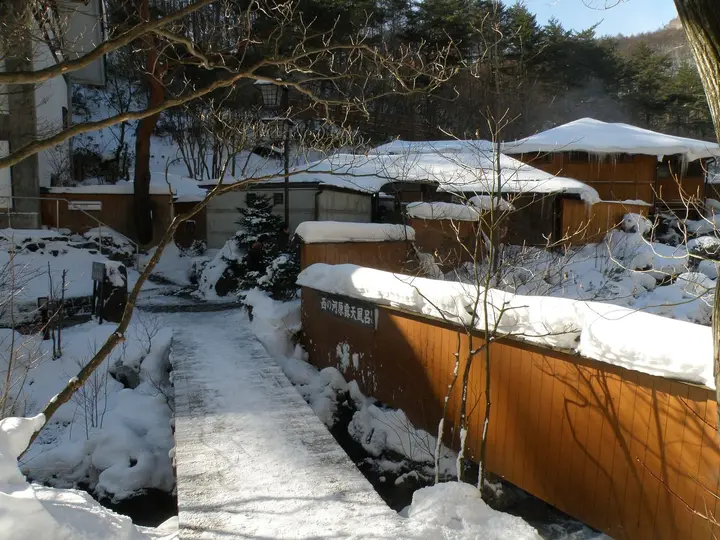
Kanbayashi Onsen is a very small hot spring village in Yamanouchi town, northern Nagano, at the foot of the Shiga Kogen highlands. There is no main street of shops and no public bathhouse. What you find instead is forest, a handful of museums and villas scattered among the trees, and four inns. It feels more like a country retreat than a resort town, which is how its inn association likes to present it.
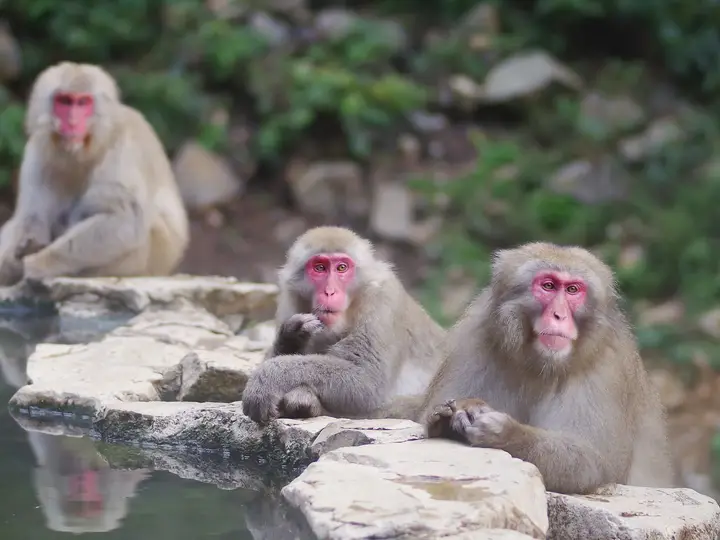
Most visitors know it for one reason: it is the closest place to stay to Jigokudani Monkey Park, where wild Japanese macaques soak in a hot pool in winter. A forest path leads from the village to the park. See our Jigokudani Monkey Park guide for the park itself.
The village also has a cultural history. The inn association traces its growth to the Meiji-era painter Terasaki Kogyo, who first stayed here in 1908 and kept returning each summer with his students. His local host built him a studio and villa and, from 1917, began piping hot water from Jigokudani. After Kogyo’s death his villa became Kogyo-ji, a Soto Zen temple. Writers including Hayashi Fumiko and the poet Miyoshi Tatsuji later stayed at the inns.
The water
Kanbayashi’s main supply is piped from Jigokudani, the valley of steaming vents just upstream. The inn association gives the flow as about 720 litres a minute, at about 149°F65°C in summer and 140°F60°C in winter, and says it is 100% natural spring water. Yamanouchi town lists it as a colourless chloride and sulfate spring. Kanbayashi Hotel Senjukaku also lists its own source, Shinyu, as a simple spring at 136.8°F58.2°C and pH 6.8.
These are source temperatures, not what you sit in; the inns do not publish tub temperatures. Senjukaku says all its tubs are fed directly with flowing source water, and Oyado Kotobuki also describes its baths as kakenagashi (flow-through). Jinpyokaku Honten says an independent inspection found the water entering its tubs is essentially the same as at the source.
The inns and their baths
All four are overnight inns. None lists day bathing on its website.
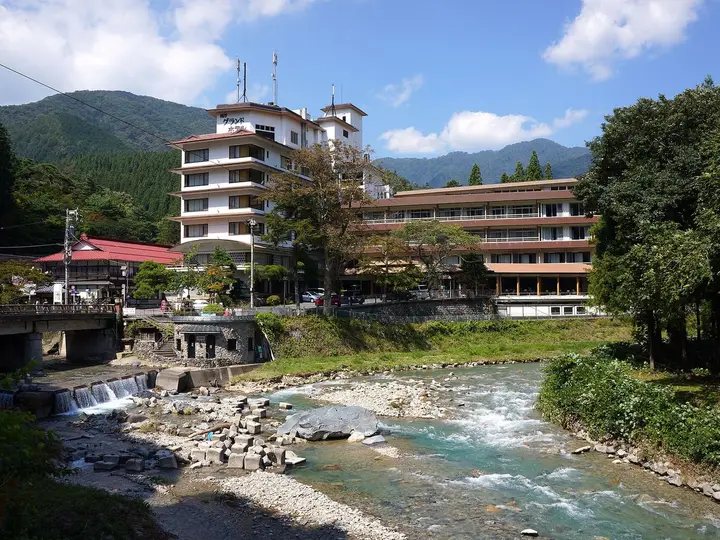
- Kanbayashi Hotel Senjukaku. Founded in 1928 and rebuilt in 1989, it mixes Japanese and Western styles and was used as a rest facility by occupation forces after the war. Its baths are an outdoor rock bath with a waterfall shower in the forest, a large indoor bath where water pours down a whole wall, and two private baths (an indoor tub with an outdoor tub beyond) at ¥1,500 per group per hour. Some rooms have their own open-air bath. The hotel posts a list of 2026 maintenance closing days.
- Jinpyokaku Honten. The inn traces itself to 1901, has six rooms and keeps its Meiji-era entrance hall. Its baths are a mixed-gender open-air bath, a men’s semi-outdoor indoor bath and a women’s indoor bath. Phone 0269-38-0222.
- Yuyado Sekiya. Founded in 1912, a wooden inn with eight rooms, each with its own open-air bath fed with flowing spring water. Three more private open-air baths (cypress, rock and a tub with jets) are free for guests with no time limit. The inn has been fully non-smoking since 2019.
- Oyado Kotobuki. A six-room inn at the start of the path to Jigokudani. It has two baths, Momiji no Yu and Shakunage no Yu, each with an indoor tub and a rock open-air tub. They are open 24 hours except for cleaning from 9:00 to 12:00, and the men’s and women’s sides sometimes swap, so check the sign before going in. The source is listed at 149.4°F65.2°C.
Onsen etiquette
The normal rules apply in the shared baths: wash at the taps before getting in, bathe naked in the gender-split baths, keep towels out of the water and tie up long hair. For the mixed open-air bath at Jinpyokaku, its website does not say whether swimsuits, bath wear or towel wraps are allowed, so ask at the desk. Private baths and in-room tubs are the easy option for couples, families and anyone with tattoos.
None of the four inns publishes a tattoo policy online. Ask when you book.
Getting there
- By train: Hokuriku Shinkansen from Tokyo to Nagano (the inns quote 80 to 100 minutes), then the Nagano Electric Railway (Nagaden) limited express to Yudanaka, about 40 to 50 minutes.
- From Yudanaka: a bus to the Kanbayashi Onsen stop takes 10 to 15 minutes; a taxi takes about 5 minutes.
- By car: leave the Joshin-etsu Expressway at Shinshu-Nakano IC and follow the Shiga-Nakano road and Route 292 toward Shiga Kogen. The inn association gives Kutsuno-Shibu IC (Kanbayashi) as the exit.
When to go
Winter is the busy season, when snow covers the forest and the monkeys in the Jigokudani pool make the famous photographs. With only four inns, rooms go early. In early February (on Risshun, the traditional first day of spring), the Sendayaki fire festival is held at the Kanbayashi Fudoson shrine, after a costumed procession from Shibu Onsen.
Outside winter the village is quieter, and the forest walks and museums are the draw. Route 292 continues uphill into the Shiga Kogen highlands.
Where to stay nearby
The four Kanbayashi inns above are the choice if you want to be closest to the monkeys. Larger choices of inns and public bathhouses are a few minutes downhill in Shibu Onsen and Yudanaka. Jigokudani Onsen Korakukan, a single inn in the valley beside the monkey park, is about 30 minutes on foot from Kanbayashi.
Lodging tax: Nagano Prefecture charges an accommodation tax from June 1, 2026. It is ¥300 per person per night, reduced to ¥200 until May 31, 2029, and is not collected when the room-only rate (before consumption tax) is under ¥6,000. Expect it on your bill at all four inns.
Safety notes
- Ice on the trail: the path to Jigokudani is packed snow and ice in winter. Wear boots with good grip or light crampons, and allow extra time.
- Wildlife: monkeys, and other animals listed by the inn association, live around the village. Do not feed or approach monkeys, and keep food out of sight.
- Hot water: the source runs at 140-149°F60-65°C and flow-through tubs can vary in temperature. Test before getting in, and keep soaks short.
- Cold: winter nights are well below freezing. Dress warmly for the walk between buildings or outdoor baths.
Map and nearby springs
GPS: 36.72961, 138.44194
Kanbayashi Onsen: common questions
How far is Kanbayashi Onsen from the snow monkeys?
The local inn association says a forest path of about 1.6 km (1 mile) runs from Kanbayashi Onsen to Jigokudani Monkey Park, about 25 minutes on foot; Yamanouchi town says about 30 minutes. In winter the path is packed snow and ice, so wear boots with grip or light crampons.
Can I visit Kanbayashi Onsen just for a bath?
None of the four inns lists day bathing on its website, so treat Kanbayashi as a place to stay rather than a day-bath stop. Ask an inn directly if you want a day visit. For public bathhouses, use the nearby Yudanaka and Shibu onsen towns.
How do I get to Kanbayashi Onsen?
Take the Hokuriku Shinkansen to Nagano (about 80 to 100 minutes from Tokyo), then the Nagano Electric Railway limited express to Yudanaka (about 40 to 50 minutes). From Yudanaka Station a bus takes 10 to 15 minutes to the Kanbayashi Onsen stop, or a taxi about 5 minutes. By car, leave the Joshin-etsu Expressway at Shinshu-Nakano IC.
Is there a mixed-gender bath at Kanbayashi Onsen?
Yes. Jinpyokaku Honten has a mixed-gender (konyoku) open-air bath alongside separate men's and women's indoor baths. Its website does not say whether bathing wear or towel wraps are allowed in the mixed bath, so ask the inn (0269-38-0222) before you go in.
Is there an accommodation tax in Kanbayashi?
Yes. Nagano Prefecture introduced a lodging tax on June 1, 2026. It is a flat ¥300 per person per night, cut to ¥200 for the first three years (to May 31, 2029), and is not charged when the room-only rate before tax is under ¥6,000. School trips and some other stays are exempt.
Closest hot springs to Kanbayashi Onsen
Jigokudani Yaen-kōen (Snow Monkey Park)
Nagano Prefecture, Japan
1 mi away, ~10 min drive
Temp n/a Paid Hike in