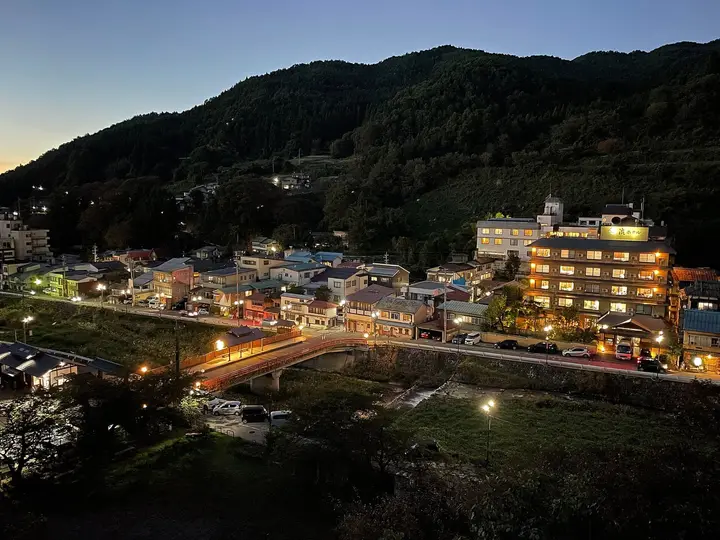
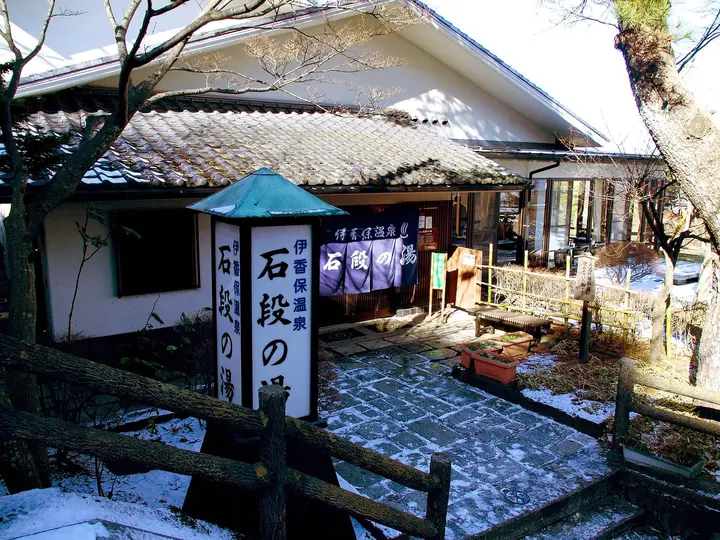
Kusatsu Onsen
Near Kusatsu, Gunma Prefecture, Japan
A highland spa town built around the steaming Yubatake, with three free communal baths, three paid day baths and some of the most acidic hot spring water in Japan.
Photos: くろふね (CC BY-SA 4.0); 雷太 (CC BY 2.0). Resized and cropped for this page.


- Water temperature
- Not published
- Entry
- Paid
- Getting in
- Drive-up
- Type
- Public pool
- Three communal baths (Shirahata-no-yu, Chiyo-no-yu, Jizo-no-yu) are free and open to visitors outside cleaning times.
- The Chōina three-bath pass covers Otakinoyu, Gozanoyu and Sainokawara once each for ¥2,100 and never expires.
- The water is strongly acidic, around pH 2, and sulfurous. Take off silver jewellery before you get in.
- Netsu-no-yu beside the Yubatake runs the yumomi water-paddling show six times a day for ¥700.
What to expect
Kusatsu sits at about 1,200 m (3,900 ft) on the eastern flank of Kusatsu-Shirane in Gunma Prefecture, and the whole town is arranged around one sight: the Yubatake, or hot water field. Spring water pours out at the top, runs down a series of long wooden channels where yu-no-hana mineral deposits collect, and drops into a pale green pool in the middle of town. Steam rises off it day and night, and the sulfur smell reaches every street.
What sets Kusatsu apart is the water itself. The tourism association puts it at about pH 2.05, which is strongly acidic, and the town likes to say a one-yen coin dissolves in about a week. The inn cooperative lists six main sources, with Shirahata as the base water: acidic, sulfurous and rich in aluminium and sulfate. It stings small cuts and can tarnish metal. Leave silver rings, earrings and watches in the locker.
Day visitors have three kinds of bath to choose from: the free communal baths used by locals, three larger paid day baths run by the town’s tourism corporation, and the inns, many of which take day guests. This page covers the public options. Sainokawara Rotenburo, the big open-air bath west of the centre, has its own separate listing on this site, so it gets only a short entry here.
The free communal baths
Kusatsu’s kyōdō-yu (communal baths) were built for residents and are still maintained by them. Three of them are listed by the tourism association as open to visitors at no charge:
- Shirahata-no-yu, right beside the Yubatake, is the largest communal bath in town and uses the Shirahata source. Open 8:00-23:00.
- Chiyo-no-yu, about 2 minutes’ walk from the Yubatake, uses Yubatake source water. Open 6:00-23:00.
- Jizo-no-yu, about 3 minutes from the Yubatake on the Jizo side of town, has slightly milky water. Open 8:00-22:00.
There are no attendants, towels, soap or lockers. Bring a small towel, undress in the shared room, rinse with a bucket of bath water before getting in, and expect the water to be hot. Each bath closes for cleaning for part of the morning, and you cannot bathe while it is being cleaned. Locals come here every day, so keep voices down and do not linger in the tub if people are waiting.
Free foot baths are easy to find too: Yukemuri-tei beside the Yubatake (24 hours), one in front of Jizo-no-yu, one opposite the bus terminal, and a large one at the Onsen-mon plaza on the town’s new entrance road.
The three paid day baths
The Kusatsu Tourism Public Corporation runs three larger baths, all fed by flowing spring water. Prices below are from the operator in October 2026. Children are aged 3 to elementary school.
| Bath | Adults | Children | Hours |
|---|---|---|---|
| Otakinoyu | ¥1,200 | ¥600 | 9:00-21:00, last entry 20:00 |
| Gozanoyu | ¥900 | ¥450 | Apr-Nov 7:00-21:00, Dec-Mar 8:00-21:00, last entry 20:30 |
| Sainokawara | ¥800 | ¥400 | Apr-Nov 7:00-20:00, Dec-Mar 9:00-20:00, last entry 19:30 |
Otakinoyu uses the Niikawa source and has a large indoor bath, an open-air bath with a hot-water fall, a sauna and the traditional awase-yu: a row of tubs (five on the men’s side) that cool naturally from one to the next, so you start in the mildest and work up. On the 2nd and 4th Saturday of each month the pipes are flushed and the normally clear water runs milky white. There is a restaurant, a rest hall, free valuables lockers, a 100-car free car park, and a towel set for ¥250.
Gozanoyu stands on the Yubatake and is a rebuilt Edo-to-Meiji style wooden bathhouse with two baths, Ki-no-yu and Ishi-no-yu, which swap between men and women daily. They carry Yubatake water (pH 2.08) and Bandai water (pH 1.7). The 2nd-floor hall overlooking the Yubatake is free to use. There is no car park; use the paid Yubatake lot.
Sainokawara is the large open-air bath, about 500 m² for men and women combined, set in woods west of the centre. Park free at Tenguyama No. 1 car park (300 spaces). On the 2nd Wednesday of most months it closes at 17:00 for cleaning.
The Chōina three-bath pass costs ¥2,100 for adults and ¥1,050 for children, covers one visit to each bath and has no expiry date. Passes bought before the price change in August 2025 are still honoured.
Getting there
From Tokyo, the operator gives these rough times:
- Train and bus via Naganohara-Kusatsuguchi: the JR limited express Kusatsu takes about 2 hours 20 minutes, then a JR bus about 25 minutes to Kusatsu Onsen Bus Terminal.
- Shinkansen via Karuizawa: about 1 hour 10 minutes on the Hokuriku Shinkansen, then a Kusakaru Kōtsū or Seibu bus taking about 1 hour 18 minutes to 1 hour 55 minutes.
- Highway bus: the JR Joshu Yumeguri-go runs from Tokyo and Shinjuku, and Tokyu Bus runs from Shibuya.
- By car: about 103 km on the Kan-Etsu Expressway and 60 km on local roads (routes 353, 145 and 292). The town is high and snowy, so in winter you need studless tyres or chains.
The bus terminal is about 5 minutes on foot from the Yubatake, and everything in this guide is within a short walk of there except Sainokawara, which is about 15 minutes’ walk from the bus terminal.
When to go
Kusatsu is open all year. Autumn colour and snow season are the busiest times, along with weekends and holidays year-round. In winter, a soak at Sainokawara with snow on the trees is the classic image. Summers are cool at this altitude.
Volcano and the pass road: Kusatsu-Shirane (around the Yugama crater lake) went to alert level 2 on August 4, 2025, which closed Route 292 over the Shiga-Kusatsu pass. The level dropped back to 1 on May 15, 2026, and the road reopened 24 hours a day on May 29, 2026. Under Article 63 of the Disaster Countermeasures Basic Act the town still bans entry within 500 m of the crater, so the road is drive-through only and the walking paths towards Shirane are closed. The town stresses that an eruption there would not reach the spa district. Route 292 also closes every winter.
Onsen etiquette
- Wash or rinse thoroughly before getting into any tub. At the communal baths, scoop water from the tub with a bucket.
- Bathe naked except during Sainokawara’s Friday mixed sessions, when wraps or swimsuits are required.
- Keep towels out of the water and tie up long hair.
- Kusatsu water is hot. Go in slowly and keep the first soak short.
- Tattoos are not refused at the three main day baths. The communal baths and inns set their own rules, so check if you are unsure.
The yumomi show
At Netsu-no-yu, on the Yubatake, performers cool the scalding spring water by churning it with long wooden boards, the traditional way Kusatsu brought its water down to a bearable heat. Shows run at 9:30, 10:00, 10:30, 15:30, 16:00 and 16:30, with an extra 15:00 show on some days. Tickets are ¥700 for adults and ¥350 for elementary school children, on sale 30 minutes before each show.
Where to stay nearby
Inns range from small family ryokan in the lanes off the Yubatake to large hotels on the edge of town. The Kusatsu Onsen Ryokan Cooperative’s site (yumomi.net) lists them. Staying the night lets you bathe in the communal baths in the quiet early hours. If you want a second Gunma spa town, Ikaho Onsen is covered at /hot-springs/ikaho-onsen-japan.
Safety notes
- Acidity: at around pH 2 the water can irritate eyes, broken skin and sensitive skin. Rinse with fresh water after bathing if you react, and keep it out of your eyes.
- Heat: the communal baths are often very hot. Test with a hand and get out if you feel dizzy.
- Metal: silver, copper and some plated jewellery tarnish quickly. Swimsuit fittings can discolour at Sainokawara.
- Winter roads: snow and ice are normal from late autumn to spring.
- Volcanic areas: obey closures around Kusatsu-Shirane. Volcanic gas can collect in hollows near vents.
A note on names: our Jizō-yu listing at /hot-springs/jizo-yu-japan is the bathhouse in Kinosaki, Hyogo, not Kusatsu’s free Jizo-no-yu described here.
Map and nearby springs
GPS: 36.62294, 138.59673
Kusatsu Onsen: common questions
Are the public baths in Kusatsu really free?
Three of them are. Shirahata-no-yu (8:00-23:00), Chiyo-no-yu (6:00-23:00) and Jizo-no-yu (8:00-22:00) charge nothing. They are run by and for local residents, have no staff, and close for cleaning for part of each morning. The three larger day baths (Otakinoyu, Gozanoyu and Sainokawara) charge an entry fee.
How much is the Kusatsu three-bath pass?
The Chōina Santō Meguri Tegata is ¥2,100 for adults and ¥1,050 for children aged 3 to elementary school, against ¥2,900 for the three baths paid separately. It gives one entry each to Otakinoyu, Gozanoyu and Sainokawara and has no expiry date. Buy it at any of the three.
Can you go to Kusatsu Onsen with tattoos?
At the three main day baths, yes. The operator says it does not refuse entry or bathing to people with tattoos, overseas visitors included, as long as they follow the bath rules. The small communal baths publish no policy, and individual inns set their own rules.
Is there mixed bathing in Kusatsu?
Every Friday from 17:30 to 20:00 (except some dates), the men's side of Sainokawara becomes a mixed bath. Everyone must cover up: men get a free bathing wrap, women can rent one for ¥400 or wear their own swimsuit, and children need a swimsuit. The women's side stays women-only.
Is Kusatsu safe given the Kusatsu-Shirane volcano?
The town says an eruption would not affect the spa district. The alert level for Kusatsu-Shirane (Yugama) was lowered to 1 on May 15, 2026 and Route 292 reopened on May 29, but the town still bans entry within 500 m of the Yugama crater, so you can only drive through that area.
How do you get to Kusatsu Onsen from Tokyo?
Take the JR limited express Kusatsu to Naganohara-Kusatsuguchi (about 2 hours 20 minutes) and a JR bus (about 25 minutes) to Kusatsu Onsen Bus Terminal. Or take the Hokuriku Shinkansen to Karuizawa and a local bus (about 1 hour 20 minutes to 2 hours). Direct highway buses run from Tokyo and Shinjuku.
Closest hot springs to Kusatsu Onsen
Jigokudani Yaen-kōen (Snow Monkey Park)
Nagano Prefecture, Japan
11 mi away, ~15 min drive
Temp n/a Paid Hike in
Near Yamanouchi (Yudanaka)
Resort or spa