Bessho Onsen
Near Ueda, Nagano Prefecture, Japan
A small, old hot spring village south of Ueda with three ¥300 public bathhouses, a larger day spa and Kamakura-era temples, reached by a local train from Ueda.
Photos: Komoro no kaze (CC BY-SA 4.0); Qiuqizhenghong (CC BY-SA 3.0). Resized and cropped for this page.


- Water temperature
- Not published
- Entry
- Paid
- Getting in
- Drive-up
- Type
- Public pool
- Three old public bathhouses, Ōyu, Ishiyu and Daishiyu, cost ¥300 each and open from 6:00 or 6:30.
- The water is a weakly alkaline simple sulphur spring that comes out at 124°F51.3°C.
- Ishiyu is known as the "hidden bath" of the warlord Sanada Yukimura.
- Anrakuji's octagonal three-storey pagoda, a National Treasure, is a short walk from the baths.
What to expect
Bessho Onsen is a small hot spring village in the hills south of Ueda, in eastern Nagano Prefecture, at about 570 m (1,870 ft). It is not a resort strip of tower hotels. It is a few streets of ryokan, soba shops and temples, built around three old public bathhouses that the village has run for generations, plus one larger modern day spa.
The village calls itself one of the oldest spring towns in Shinshū (the old name for Nagano). Legend credits the springs to Prince Yamato Takeru, and the “Nanakuri” hot spring named in Sei Shōnagon’s Pillow Book is often linked to Bessho. The nickname “Kamakura of Shinshū” comes from the 13th and 14th centuries, when the Shiota Hōjō family ruled the area and backed its temples. In 2020 the Agency for Cultural Affairs named the area a Japan Heritage site.
What draws most people is the combination: a cheap soak in a wooden-roofed bathhouse, then a walk to Anrakuji, Jōrakuji and Kitamuki Kannon, all within a few minutes of the baths.
The public baths
The springs, the three public bathhouses and the two foot baths belong to the Bessho Onsen property ward, a local public body. All three old bathhouses are indoor baths with separate men’s and women’s sides, and all cost ¥300.
- Ishiyu (石湯). Known as Sanada Yukimura’s “hidden bath,” after the Sengoku-era warlord. Water from source No. 4, flowing through the bath with circulating filtration. 6:30 to 21:30, closed Tuesdays. Phone 0268-38-0243.
- Ōyu (大湯). Linked to Kiso Yoshinaka and the Hōjō, and once called Aoi no Yu. Water from source No. 4 and the Ōyu source, also flow-through with filtration. 6:30 to 21:30, closed Wednesdays. Phone 0268-38-0245.
- Daishiyu (大師湯). Named for the monk Jikaku Daishi (Ennin). Water from source No. 3, fully flow-through with no recirculation. 6:00 to 21:00, closed Thursdays. Phone 0268-38-0244.
- Aisome no Yu (あいそめの湯). The city-run day spa near Bessho-Onsen Station, rebuilt in 2008. It has large indoor baths and an open-air bath, a hot-stone room (ganbanyoku, ¥650 including wear and towels), a lounge, a hall and the restaurant Biranju. 10:00 to 22:00, last entry 21:20, closed the 2nd and 4th Mondays.
- Foot baths. “Nanakuri” (6:00 to 21:00 from March to October, 9:00 to 18:00 from November to February) and “Ōyu Yakushi no Yu” (6:00 to 21:00 from April to November, closed December to March). Both are free and have no closing day.
The tourism association warns that closing days can move around public holidays and posts a yearly calendar on its site.
The water
Bessho’s water is a simple sulphur spring, classed as low-tonicity, alkaline and high-temperature. It comes out of the ground at 124°F51.3°C and is weakly alkaline. Expect a light sulphur smell and soft, slightly slippery water. The tourism association promotes it as good for the skin. We do not publish health claims, but the softness is easy to notice.
Prices and booking
- Ōyu, Ishiyu, Daishiyu: ¥300. No child rate is listed. On the 26th of each month (“bath day”), elementary school children and younger get in free.
- Aisome no Yu: adults ¥650, elementary and junior high students ¥300, preschoolers free. Disability certificate holders ¥320 (students ¥150).
- Foot baths: free.
None of these take bookings. At the old bathhouses, bring your own towel and soap, or buy them at the counter. Valuables lockers take a ¥100 coin that you get back, and the women’s sides at Ishiyu and Ōyu have paid hair dryers. Aisome no Yu provides soap, shampoo and dryers, and rents bath and face towels.
Onsen etiquette
The old bathhouses are small and used by local people every day, so manners matter:
- Wash and rinse before you get in. Bring your own soap or buy it at the counter.
- Bathe naked. No swimsuits, and keep your towel out of the water.
- Keep it short when it is busy, and do not take up a washing station with your things.
- No photos inside.
- The tourism association suggests waiting about an hour after arriving or eating before you bathe, and starting with 5 to 10 minutes in the water.
Tattoo rules are not published. Ask at the counter before you pay.
Getting there
Bessho Onsen is the end of the line on the Ueda Electric Railway Bessho Line, which starts at Ueda Station. Ueda is on the Hokuriku Shinkansen between Tokyo and Nagano. The Bessho Line takes about 30 minutes end to end.
From Bessho-Onsen Station, Aisome no Yu is close by, Ōyu is a 7 to 8-minute walk, and the Kitamuki Kannon area is about 15 minutes. The two halves of the village are less than 10 minutes apart on foot.
The Bessho Line was cut for a year and a half after Typhoon Hagibis destroyed its Chikuma River bridge in October 2019. Through trains from Ueda returned on March 28, 2021.
By car, Bessho is reached from Ueda. The tourism association’s access page gives driving routes as images only, so check a map app for the current route.
When to go
The baths are open all year, and the village is small enough to do in a half day. Autumn brings colour on the hills and the local matsutake mushroom season, when seasonal restaurants open in the woods. Spring and early summer are pleasant for walking between the temples. In winter, note that the Ōyu Yakushi no Yu foot bath closes from December to March.
Mornings are the quietest time at the old bathhouses, which open at 6:00 or 6:30.
Where to stay nearby
Around a dozen ryokan belong to the village’s inn association, several founded in the Edo period, and there are a few guesthouses, minshuku and a youth hostel. The ryokan have their own baths fed from the village springs. Ueda, about 30 minutes away by train, has business hotels and Ueda Castle, the old seat of the Sanada family.
Nearby stops worth adding
Anrakuji has an octagonal three-storey pagoda that survived the burning of the temple in the 12th century and was named a National Treasure in 1952. Kitamuki Kannon, whose hall burned in 1712 and was rebuilt in 1721, sits at the heart of the Innai district. Jōrakuji is close by. All three are an easy walk from the baths.
Safety notes
- Heat: the water is hot at source and the old baths have small tubs with little room to cool off. Get out if you feel dizzy and drink water.
- Alcohol and meals: avoid bathing right after a meal or drinking.
- Winter footing: the lanes between the temples are sloped and can ice over in winter.
Map and nearby springs
GPS: 36.34978, 138.15487
Bessho Onsen: common questions
How much are the public baths at Bessho Onsen?
The three old bathhouses, Ōyu, Ishiyu and Daishiyu, each cost ¥300. Aisome no Yu, the larger day spa by the station, costs ¥650 for adults and ¥300 for elementary and junior high students, with preschoolers free. The two foot baths are free.
When are the Bessho Onsen bathhouses closed?
Each has a weekly closing day: Ishiyu on Tuesdays, Ōyu on Wednesdays and Daishiyu on Thursdays. Aisome no Yu closes on the 2nd and 4th Mondays (the next day if that Monday is a holiday). The tourism association says days can shift around public holidays and posts a yearly calendar.
How do you get to Bessho Onsen?
Take the Hokuriku Shinkansen or another JR line to Ueda, then the Ueda Electric Railway Bessho Line to Bessho-Onsen Station at the end of the line, about 30 minutes. Ōyu is a 7 to 8-minute walk from the station and the Kitamuki Kannon area about 15 minutes.
Do I need to bring a towel and soap?
Yes for the three old bathhouses. Towels, soap, shampoo and razors are sold at the front counter, but nothing is lent free. Aisome no Yu provides body soap, rinse-in shampoo and hair dryers, and rents towels.
Is there an outdoor bath at Bessho Onsen?
Aisome no Yu has an open-air bath included in its ¥650 fee. The three old bathhouses are indoor baths. Many of the village's ryokan have their own baths for staying guests.
Closest hot springs to Bessho Onsen
Near Yamanouchi (Yudanaka)
Resort or spa
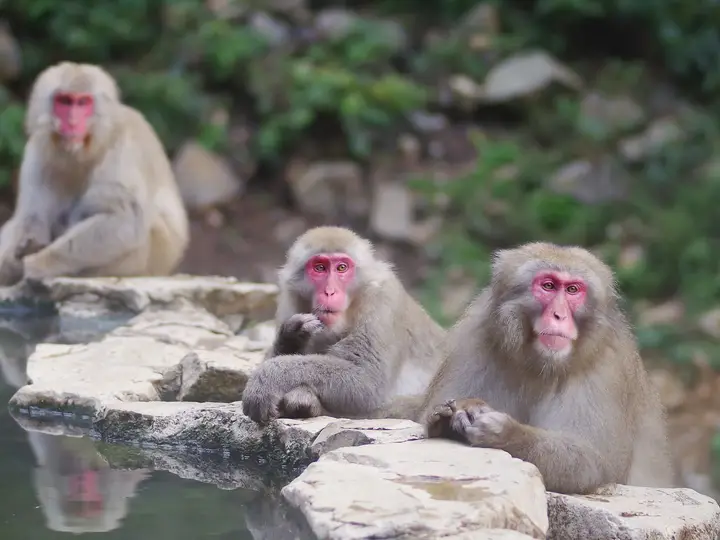
Jigokudani Yaen-kōen (Snow Monkey Park)
Nagano Prefecture, Japan
31 mi away, ~50 min drive
Temp n/a Paid Hike in