Thermopylae Hot Springs
Near Lamia, Fthiotida, Greece
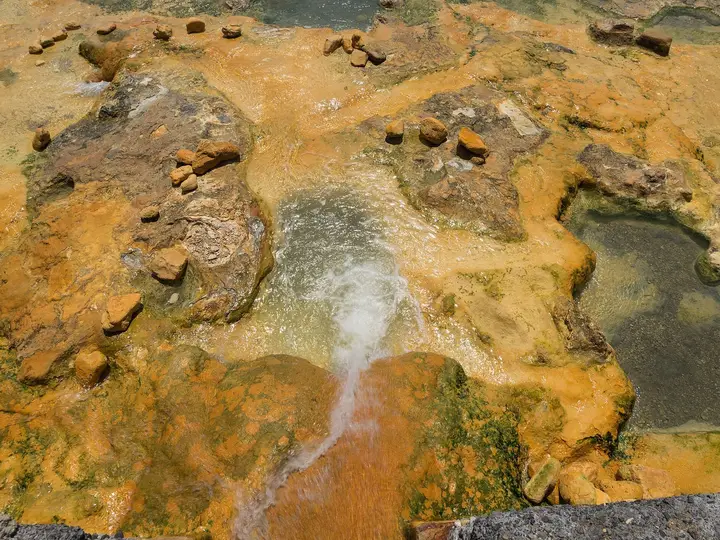
A free, unmanaged hot stream about 1 km west of the Leonidas monument, where 104-111°F40-44°C sulphur water drops over a small travertine waterfall into a chain of natural pools beside the old national road.
Photos: Calistemon (CC BY-SA 4.0); Michal Jančina (CC BY 3.0); Fkerasar (CC BY-SA 3.0). Resized and cropped for this page.


- Water temperature
- 104-111°F40-44°C
- Entry
- Free
- Getting in
- Drive-up
- Type
- Wild & natural
- Free and open at any time. There is no operator, so no ticket, no staff and no facilities.
- A travertine waterfall about 2 m (6.5 ft) high spills into a series of natural pools.
- The springs gave the pass its name: Thermopylae means "hot gates".
- The Leonidas monument, Kolonos Hill and the Thermopylae Historical Information Centre are about 1 km (0.6 miles) east.
What to expect
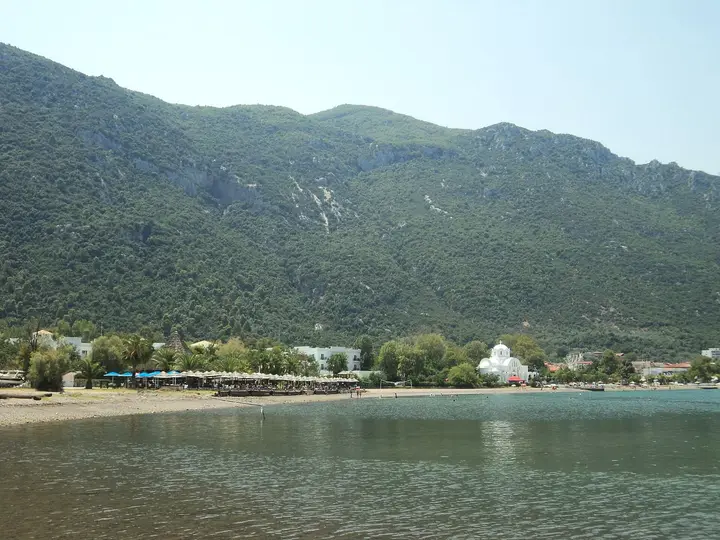
Thermopylae is one of the most famous names in Greek history, and the springs are the reason for it. Herodotus called the pass the “hot gates” after the warm water that ran out of the foot of Mount Kallidromo. Today the springs are a free, unmanaged soaking spot a short way west of the battlefield memorial, on the old national road between Athens and Lamia in Fthiotida.
What you find is a hot stream rather than a pool complex. Sulphur water runs down a channel lined with pale travertine, drops over a small waterfall about 2 m (6.5 ft) high, and fills a series of natural basins below it. People sit under the falling water for a hot shower, or lie in the basins downstream where it is a degree or two cooler. A second small hot pond sits a couple of hundred metres to the south-west.
A March 2026 report in the newspaper Efsyn measured the water at 104-111°F40-44°C. That is hot enough that most people soak in short spells. The smell of hydrogen sulphide hangs over the whole area, and the minerals stain light swimwear.
There are no facilities: no changing rooms, toilets, showers, bins or kiosk. The old spa buildings beside the stream are not open to bathers (see below).
The old spa
A spa was built at the springs in 1935, and for decades the state ran a seasonal bathhouse here. The spa unit’s own news page, hosted on the Ypati spring website, stops at a 2013 operating notice. The buildings are now mapped as a refugee accommodation site, and a geocache page describes them as housing for refugees from Africa. In 2018 Efsyn reported that the state privatisation fund planned to offer Thermopylae to investors together with the Ypati and Kamena Vourla springs. We found no sign of a reopening, so treat the stream as the only place to soak.
The landscape and the battle
The “narrow pass” of 480 BC no longer exists. The Sperchios River has pushed its delta more than 5 km (3 miles) out into the Malian Gulf. Geoarchaeological drilling during construction of the motorway showed that at the time of the battle the ground between the mountain and the sea was a warm, spring-fed marsh more than 300 m wide, and that the hot water has laid down about 13 m (43 ft) of travertine in the 2,500 years since. The low mound you walk past on the way is built of that rock.
Getting there
The springs are about 1 km (0.6 miles) west of the Leonidas monument, on the old national road (the pre-motorway Athens-Lamia road) that runs along the foot of Kallidromo.
- From Athens: Take the A1 motorway north past Kamena Vourla. Leave at the Thermopylae exit, or use the old national road from Kamena Vourla, which runs parallel to the motorway and avoids the tolls. Kamena Vourla itself is about 177 km (110 miles) from Athens.
- At the monument: Pass the Leonidas memorial and slow down. About 1 km farther on, a sign on the left points to the thermal springs. Park on the access road.
- From Lamia: Head south-east on the old national road toward Thermopylae and Kamena Vourla. The turn is before the monument coming from this direction.
There is no local bus to the springs. A car is the practical way to come; taxis run from Lamia.
From the parking area it is a walk of a minute or two to the stream. Getting down into the basins is the awkward part. Visitors have rigged a rope and rough steps on the travertine, which is uneven and slippery.
When to go
The springs flow all year and there are no opening hours.
- October to May is the best time. The hot water feels right when the air is cool, and steam rises off the stream on winter mornings.
- Summer afternoons in Fthiotida can pass 95°F35°C, and a 108°F42°C stream is hard work in that heat. Come early in the morning or toward sunset.
- Weekends and holidays bring local families and day-trippers from Lamia. Weekday mornings are quieter.
- After heavy rain, the ground around the stream turns muddy and the rocks become slicker.
Rules and etiquette
There is no operator and no posted rule board, so the rules are common sense:
- Swimsuits. This is a roadside spot used by local families. Change discreetly; there are no cabins.
- No soap or shampoo in the stream.
- No glass. Broken glass in a shallow pool is a real hazard when nobody cleans up.
- Take your rubbish with you. There are no bins.
- Do not dam or dig the channel. Changing the flow can flood the lower pools or make one spot much hotter.
- Respect the buildings. The old spa compound has been used as housing. Do not wander into it.
Where to stay nearby
There is no lodging at the springs.
- Kamena Vourla, about 20 km (12 miles) east on the coast, has seafront hotels and rooms, the spa resort in the old spa quarter, and the free pools at Koniaviti and Kallyntika.
- Lamia, the regional capital to the north-west, has city hotels, restaurants and taxis.
- Loutra Ypatis, beyond Lamia at the foot of Mount Oiti, is an old spa village full of small hotels next to the Ypati thermal spring.
- Agios Konstantinos, a short drive east of Kamena Vourla, has more rooms on the waterfront.
Safety notes
- Hot water. At 104-111°F40-44°C, limit soaks to 10 minutes or so, cool off between dips, and drink water. Get out if you feel dizzy. People with heart conditions, pregnant women and young children should be especially careful.
- Footing. The travertine and the rope access are the main risks. Wear sandals with grip, use the rope, and do not jump into the basins; they are shallow.
- Hydrogen sulphide. The smell is normal in the open air. Do not crouch for long in hollows where the gas can collect.
- Water quality. The stream is untreated. Keep your head above water and do not swallow it.
- Valuables. Do not leave bags visible in the car at a roadside pull-off.
Nearby stops worth adding
The Leonidas monument (1955) and Kolonos Hill, where the Spartans made their last stand and where the epitaph of Simonides is set in stone, are about 1 km (0.6 miles) east. The Thermopylae Historical Information Centre next to them tells the story of the battle with films and displays.
Psoroneria, also called the Kallidromo thermal baths, is a small spring-fed lake about 5 km (3 miles) away near the village of Damasta. The water stays around 91°F33°C, there are steps into the lake, a small car park and simple changing cabins. It is milder and easier to get into than the Thermopylae stream.
Across the Malian Gulf, the seafront springs of Edipsos on Evia are reached by the car ferry from Arkitsa, or from Glyfa to Agiokampos, a short drive from Edipsos.
Map and nearby springs
GPS: 38.79343, 22.52851
Thermopylae Hot Springs: common questions
Are the Thermopylae hot springs free?
Yes. The hot stream and its pools are open ground with no gate, ticket office or staff. Park beside the access road and walk the last few metres.
How hot is the water at Thermopylae?
A March 2026 report put the water at 104-111°F40-44°C, which is properly hot. It smells strongly of hydrogen sulphide (rotten eggs). The pools farther from the waterfall are a little cooler.
Is there a bathhouse at Thermopylae?
Not a working one. A spa was built at the springs in 1935, but the state spa unit published no news after 2013, and the old buildings beside the springs have since been used as accommodation for refugees. You soak in the open stream or not at all.
Is it easy to get into the pools?
Not very. Access is over rough, improvised steps and a rope, and the travertine is slippery. It is fine for confident adults in good shoes, but awkward for older visitors and small children.
How far is it from the Thermopylae monument?
About 1 km (0.6 miles). Follow the old national road from the Leonidas monument toward Lamia and look for the sign on the left to the springs.
Are there other free hot springs nearby?
Yes. Psoroneria, a warm spring-fed lake about 5 km (3 miles) away near Damasta, has steps into the water and changing cabins, and the free Koniaviti and Kallyntika pools at Kamena Vourla are about 20 km (12 miles) east.
Closest hot springs to Thermopylae Hot Springs
91-95°F33-35°C
Public pool
Kallyntika Springs (Aphrodite Pools)
Fthiotida, Greece
12 mi away, ~20 min drive
91-95°F33-35°C Free Drive-up
90-95°F32-35°C
Public pool
Koniaviti Thermal Springs (Mylos Koniaviti)
Fthiotida, Greece
12 mi away, ~20 min drive
90-95°F32-35°C Free Drive-up
92°F33°C
Public pool
Ypati Thermal Spring (Loutra Ypatis)
Fthiotida, Greece
15 mi away, ~25 min drive
92°F33°C Paid Drive-up
Loutra Smokovou (Smokovo Thermal Baths)
Karditsa, Greece
36 mi away, ~55 min drive
99-104°F37-40°C Paid Drive-up