Therma Beach Hot Spring (Embros Thermae)
Near Agios Fokas, Kos, Greece
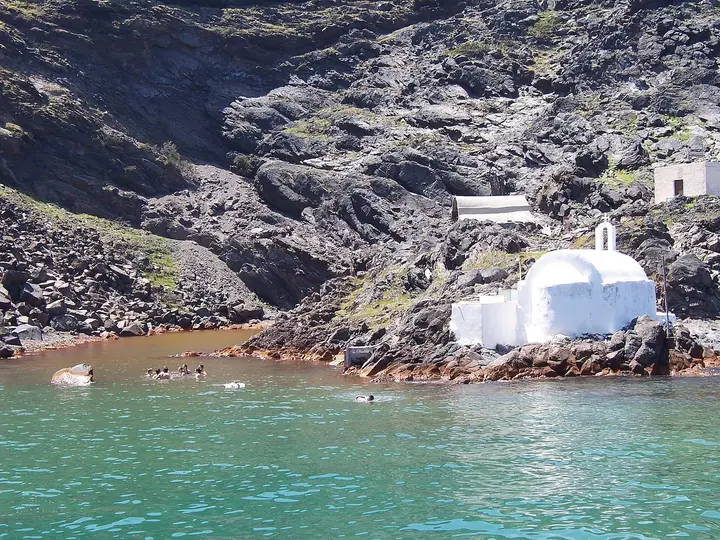
A free, rock-ringed pool on a dark pebble beach below the cliffs of south-east Kos, where sulphurous water at about 113-122°F45-50°C pours out of the rock and mixes with the sea.
Photos: kallerna (CC BY-SA 3.0); Rikki Mitterer (CC BY-SA 4.0); Robert Powell (CC BY-SA 3.0). Resized and cropped for this page.


- Water temperature
- 86-122°F30-50°C
- Entry
- Free
- Getting in
- Short walk
- Type
- Wild & natural
- Entry is free and there are no set hours. Locals and visitors soak at all times of day and night.
- The pool is a ring of boulders about 25 m² (270 sq ft) where the spring meets the sea, so you choose your temperature by moving away from the outflow.
- Gas bubbles rise from the seabed around the pool.
- Municipal KEAS bus line 5 runs from Kos Town to a stop called Therma at the top of the road.
What to expect
Therma beach, also called Embros Thermae (Εμπρός Θέρμες, “the front baths”), is at the south-eastern tip of Kos, just past the resort strip of Agios Fokas and about 12-13 km (7.5-8 miles) from Kos Town. The coast here is a line of steep grey cliffs, and the beach below them is a narrow strip of dark pebbles and dark sand with deep, clear water.
The hot spring comes out of a crack in the rock at the back of the beach. Someone long ago piled boulders into a rough ring at the waterline, and that ring is the pool: roughly 25 m² (270 sq ft), open to the sea on one side, with hot water pouring in from the other. The two mix inside the ring, so the temperature changes with every step. Near the outflow it is scalding. Toward the seaward rocks it feels like a warm bath. When a wave washes over the wall you get a cold surge, then the heat comes back.
The water smells of sulphur, and small bubbles of gas rise from the seabed around the pool, which you can feel on your skin. Out beyond the boulders you can swim in ordinary sea water, and many people alternate between the two.
There is one small beach bar that rents sunbeds and umbrellas in summer. Older Greek travel pieces describe the buildings that once stood here as abandoned; do not expect changing rooms, showers or toilets on the beach. A massage booth sometimes sets up in season.
The water
The municipal tourism site gives the spring as 108-122°F42-50°C, with the hottest water closest to the source, and the German Wikipedia entry puts the outflow at 120°F49°C. A local guide reports that the flow increased after the 2017 Kos earthquake and that the water near the outflow became hotter, which is why most people now sit nearer the sea side of the pool.
The water carries sulphur, potassium, calcium, magnesium and sodium. Local guides say it has long been used for skin, muscle and joint complaints, and one notes that during the Italian administration of the Dodecanese the water was shipped to Italy in quantity. We make no health claims for it.
Getting there
- By car or scooter from Kos Town: Follow the coast road south-east past Psalidi and Agios Fokas and keep going until the asphalt ends at a dead end above the cliffs, about 12-13 km (7.5-8 miles) in all. There is a free car park there, a few minutes on foot from the beach, with cafes nearby.
- By bus: The municipal KEAS city bus runs line 5 from the centre of Kos Town toward Agios Fokas and Therma. The Therma stop has a shelter and a timetable board. Check current times in town, since summer and winter schedules differ.
- The walk down: From the car park a dirt path drops steeply down the cliff to the beach. It is short but loose and uneven in places. The climb back up in the midday sun is the part people remember. Sandals with a strap or trail shoes are better than flip-flops.
The path rules out wheelchairs and makes it hard going for anyone unsteady on their feet.
When to go
The spring runs all year, and because it is open access you can visit at any hour. Locals come at night and early in the morning.
- May, June, September and October are the easiest months: the sea is warm enough to swim, the beach bar is usually open, and the crowds are thinner than in high summer.
- July and August are busy. The pool is small, so it fills up by late morning. Come early, or after the tour boats and day trips have gone in the evening.
- Winter is when a hot pool makes the most sense, and you may have it almost to yourself. Facilities will be closed, and rough seas can wash over the wall and cool the pool down.
Calm days are best. When a strong wind pushes swell onto this coast, waves break over the boulders and the pool loses its heat.
Rules and etiquette
Nobody runs the pool, so the rules are the ones regulars keep:
- Share the space. The ring of rocks is small. Do not stretch out across the warm middle for an hour when others are waiting.
- No soap, shampoo or glass in or around the pool.
- Swimsuits are the norm. This is a public beach used by families.
- Do not move the boulders. Shifting rocks to change the flow can make the pool dangerously hot in one spot or let the sea flood it.
- Take your rubbish back up the path. There are no bins on the beach.
Where to stay nearby
There is nothing to stay in on the beach itself.
- Agios Fokas and Psalidi, a short drive back along the coast, have a long line of beach hotels and resorts, from large all-inclusive complexes to small apartments.
- Kos Town, 12-13 km (7.5-8 miles) away, has the widest choice of rooms, plus the harbour, the old town and the archaeological sites.
- Buses back to town make it easy to visit without a car if you stay along the Psalidi road.
Safety notes
- Scalding water at the outflow. The spring comes out at close to 122°F50°C. Test the water with your hand before you sit, stay on the sea side of the pool, and keep children and anyone with heart or circulation problems away from the hot corner.
- Short soaks. Get out and cool off in the sea every 10 to 15 minutes, and drink water. It is easy to overheat in a hot pool under a summer sun.
- Footing. The boulders that make the pool wall are smooth and slick with algae. Most scrapes and twisted ankles here come from climbing in and out.
- The cliff path. Take it slowly on the way down and allow time for the climb back up. Avoid it in the dark without a torch.
- Rockfall. The beach sits under steep cliffs. Do not linger right at their base, especially after heavy rain or an earthquake.
- Waves. In rough weather, surges can knock you against the rocks. Stay out on days when the sea is breaking over the wall.
Nearby stops worth adding
Agia Eirini, also known as Piso Thermi (“the back baths”), is a second spring with reddish water on the coast south-west of Agios Fokas. It is hard to reach on foot and is usually visited by boat.
From Kos harbour, boats cross to the volcanic island of Nisyros, where you can combine a walk into the volcanic crater with a visit to the Nisyros thermal baths.
Back in Kos Town, the ancient agora, the Roman Odeon and the Asklepieion just outside town make a good half day before or after a late swim at Therma.
Map and nearby springs
GPS: 36.84460, 27.31653
Therma Beach Hot Spring (Embros Thermae): common questions
Is Therma beach hot spring free?
Yes. The hot pool on the beach is open to anyone at no charge, and the car park at the road end is free. The small beach bar rents sunbeds and umbrellas in season if you want them.
How hot is the water at Therma beach?
It depends on where you sit. The municipal tourism site gives 108-122°F42-50°C for the spring, which flows out of the rock at around 113-122°F45-50°C, and the sea cools it as you move outward. Older guides put the pool at anywhere from 86-122°F30°C to 50°C. Right at the outflow it is too hot to stay in.
How do you get down to Therma beach?
Drive or take the bus past Agios Fokas to the end of the road. From the car park a steep, rough path drops down the cliff to the beach in a few minutes. Wear proper shoes, because the climb back up is the hard part.
Are there toilets or showers at the hot spring?
Not on the beach. There is a seasonal beach bar, and cafes sit near the car park at the top. Bring water, a towel and shade, since natural shade is limited to a few spots under the rocks.
Is it suitable for children?
Yes, with care. Keep children well away from the outflow, where the water is close to 122°F50°C, and watch them on the steep path and the slippery boulders that form the pool wall.
Closest hot springs to Therma Beach Hot Spring (Embros Thermae)
115°F46°C
Public pool
Loutra Nisyrou (Mandraki Thermal Baths)
Nisyros, Greece
18 mi away, ~30 min drive
115°F46°C Paid Drive-up
Near Therma
Public pool
95-99°F35-37°C
Public pool
Gülbahçe Roman Bath (Kleopatra Hamamı)
İzmir, Turkey
109 mi away, ~3 hr drive
95-99°F35-37°C Free Short walk