Loutra Nisyrou (Mandraki Thermal Baths)
Near Mandraki, Nisyros, Greece
The municipal thermal baths at Loutra, about 1 km from Mandraki harbour on volcanic Nisyros: a listed 19th-century stone complex, now far quieter than in its heyday. Call before you go.
- Water temperature
- 115°F46°C
- Entry
- Paid
- Getting in
- Drive-up
- Type
- Public pool
- Three listed stone buildings from 1885 to 1912 once held 300 beds and 27 bathtubs.
- The municipality still lists a phone line for the baths, +30 22420 31284.
- The spring reaches up to 114.8°F46°C by the municipality's figure.
- It is about 1 km (0.6 miles) from the harbour where day boats from Kos land.
What to expect
Loutra (also called Therma) is a cluster of large stone buildings on the shore about 1 km (0.6 miles) east of Mandraki, the harbour town of Nisyros. You can see them from the small breakwater where the boats tie up. For the first half of the 20th century they made this small volcanic island in the Dodecanese a spa destination, with visitors from the other islands, the coast of Asia Minor and Greek communities in Egypt.
The baths belong to the municipality, which lists them, with a phone number, among its services. What you will find when you arrive is the open question. Some guides describe a modest working bath with tubs in part of the old complex. A detailed travel feature published in August 2026 described the baths in the past tense: reopened from 1955 to 1990, then a slow decline because maintenance cost too much, with restoration studies drawn up a few years ago. Phone ahead, and treat a working bath as a bonus. Even if nothing is running, the buildings and the seafront walk from Mandraki are worth the stop.
The buildings
The Mandraki community built the first baths in 1885, using money from wealthy islanders and nepetia, the old custom of compulsory communal labour. The west wing followed about ten years later and the east wing by 1911-1912. At their peak the three wings held 300 beds, a restaurant and 27 bathtubs. During the Second World War they housed an orphanage. The buildings are now listed for preservation as a rare mix of folk and plain neoclassical architecture, with a small chapel in the yard and a jetty on the north side.
The water
The Nisyros springs are a mix of rain water, sea water and fluids from the volcano’s shallow hot layer, rising along cracks to the coast. The municipality classes the Loutra spring as thermal water rich in hydrogen sulphide, with a maximum of 114.8°F46°C. Older sources give 131-140°F55-60°C for the spring at the height of the spa. The baths were marketed for arthritis, rheumatism, skin complaints and circulation problems.
Getting there
- From Kos: Summer day boats leave Kardamena in the morning and take about an hour to Mandraki. Other ferries from Kos take about 1.5 hours.
- From Piraeus: Blue Star Ferries call at least twice a week all year, about 13.5 hours. Book a cabin.
- From Rhodes: Some ferries and a catamaran via Tilos link Nisyros with Rhodes on certain days.
- On the island: From Mandraki harbour, walk or drive east along the coast road toward Pali. The baths are on the shore after about 1 km (0.6 miles). The island bus (Mandraki-Loutra-Pali-Emporeios-Nikia) stops at Loutra.
When to go
Day boats from Kos run in summer, and Piraeus-Rhodes ferries call less often in winter. Day-trippers on the Kos boats arrive mid-morning and leave mid-afternoon, so the crater and Mandraki are busiest in between. May, June and September are the easiest months for a combined trip to the baths and the volcano.
Prices and booking
The municipality does not publish hours or prices for the baths. Call the bath line on +30 22420 31284 (or +30 22420 360514, which also serves the municipal tourism company and the Polyvotis municipal hostel) before you plan around a soak. The historic complex was built around individual bathtubs rather than an open pool, so bring a towel and ask what is available.
Where to stay nearby
- Mandraki, 1 km (0.6 miles) away, is the island’s main town, with hotels, rooms and the municipal Polyvotis hostel (+30 22420 31011).
- Pali, a fishing village and marina a few kilometres east, has a sandy beach with a view of the old Pali bath buildings.
- Emporeios and Nikia are the villages up on the caldera rim, on the island bus route.
Safety notes
- Hot water: At up to 114.8°F46°C at the source, any tub filled straight from the spring is too hot to get into without mixing. Test it first.
- Old buildings: Parts of the complex have been out of use for decades. Stay out of closed or fenced sections.
- Volcano: On the crater floor, stay on the marked paths, keep away from steaming vents and do not let children run ahead. The ground can be hot.
Nearby stops worth adding
The Stefanos crater in the caldera is the island’s main sight: 27 m deep and 330 m across, one of the largest and best preserved hydrothermal craters anywhere. You walk down onto its floor among sulphur vents. Wikivoyage listed a €3 entry charge in 2018, free if you hike in. At Avlaki, hot water up to 141.8°F61°C gushes into the sea. Outside Pali, the ruins of Roman baths sit inside the rock at Thermiani under the chapel of Panagia Thermiani, next to the 1910 Hippocrates spa built by Dr Ippokratis Pantelidis and abandoned after his death in 1928; the municipality says the old Pali baths have been restored but are not yet ready to operate. Near Emporeios, a warm cave works as a natural sauna. The Cyclopean walls of Paleokastro, the ancient city at Mandraki, are built from volcanic stone.
Map and nearby springs
GPS: 36.61233, 27.15343
Loutra Nisyrou (Mandraki Thermal Baths): common questions
Are the Nisyros thermal baths open?
Sources disagree, so call before you go. The municipality lists a phone line for the baths (+30 22420 31284) under its tourism company, and some guides describe a modest working bath at Loutra. An August 2026 travel feature, however, said the historic complex worked from 1955 to 1990 and then declined because upkeep was too costly, with restoration studies prepared but no works reported.
How hot is the water at Loutra?
The municipality gives a maximum of 114.8°F46°C for the Loutra spring. Older accounts quote 131°F55°C or 140°F60°C at the spa's peak. It is classed as thermal water rich in hydrogen sulphide.
How do I get to Nisyros?
Summer day boats from Kardamena on Kos take about an hour, and other ferries from Kos about 1.5 hours. Blue Star ferries from Piraeus call at least twice a week all year and take about 13.5 hours. The baths are about 1 km (0.6 miles) east of Mandraki harbour on the road to Pali.
Are there other hot springs on Nisyros?
Yes. At Avlaki hot water up to 141.8°F61°C gushes into the sea. Near Pali, the Roman baths at Thermiani and the 1910 Hippocrates spa built by Dr Ippokratis Pantelidis are historic sites; the municipality says the old baths there were restored but were not yet ready to operate.
Can I combine the baths with the volcano?
Easily. The Stefanos crater in the caldera is 27 m deep and 330 m across, and most visitors walk down into it. Wikivoyage listed a €3 entry charge in 2018, free if you hike in. Check the current fee on arrival.
Closest hot springs to Loutra Nisyrou (Mandraki Thermal Baths)
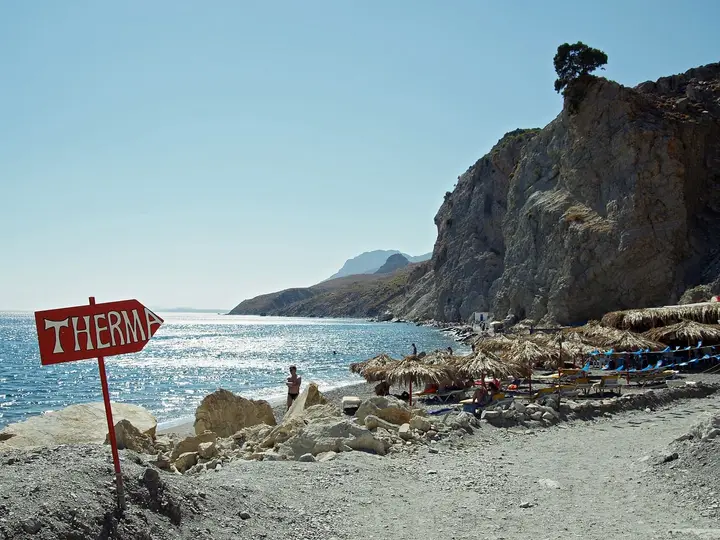
Therma Beach Hot Spring (Embros Thermae)
Kos, Greece
18 mi away, ~30 min drive
86-122°F30-50°C Free Short walk
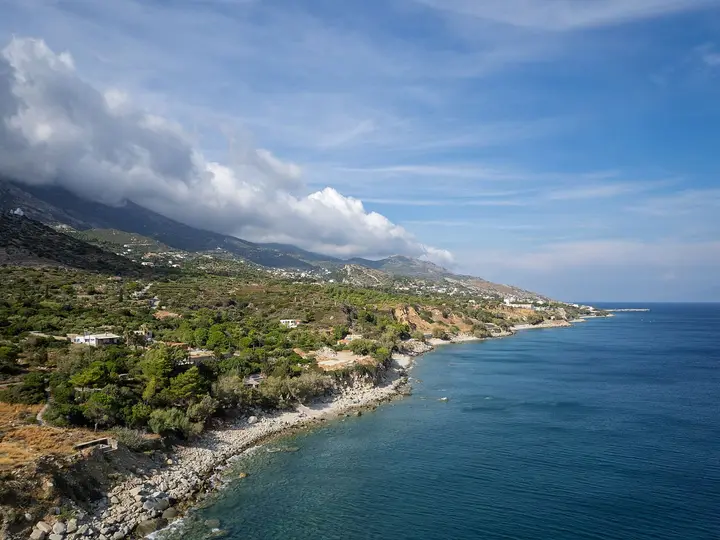
Near Therma
Public pool
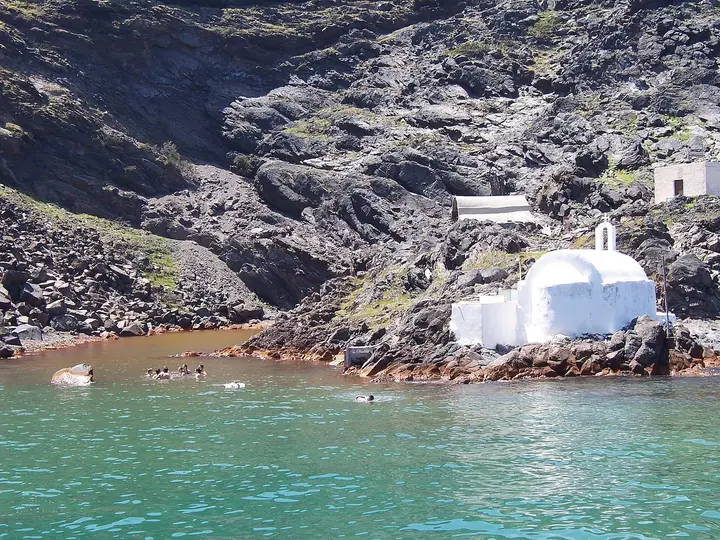
95-99°F35-37°C
Public pool
Gülbahçe Roman Bath (Kleopatra Hamamı)
İzmir, Turkey
122 mi away, ~3 hr drive
95-99°F35-37°C Free Short walk