Terme di Fiuggi (Fonte Bonifacio VIII and Fonte Anticolana)
Near Fiuggi, Lazio, Italy
Two historic spring parks in the spa town of Fiuggi, south-east of Rome, where you drink a cold, very low-mineral water at the fountains. There is no bathing: the water rises at 54°F12.4°C.
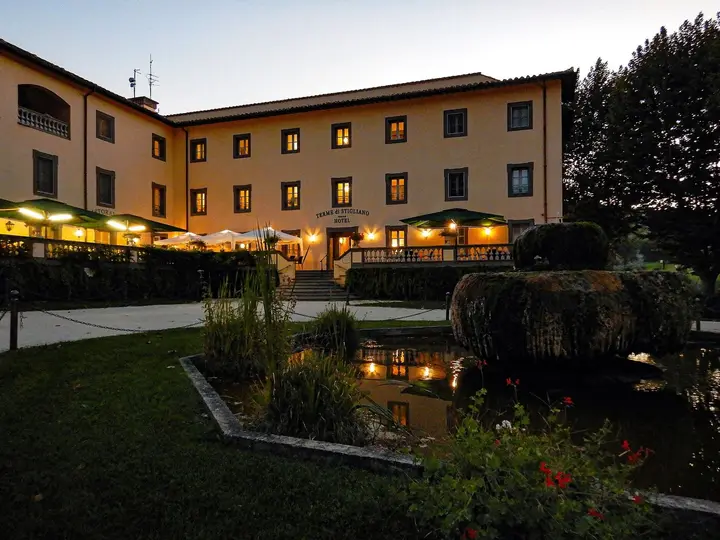
Photos: LPLT (CC BY-SA 3.0); pietro scerrato (CC BY 3.0). Resized and cropped for this page.


- Water temperature
- Not published
- Entry
- Paid
- Getting in
- Drive-up
- Type
- Resort or spa
- There is nothing to soak in: the cure is drinking the cold Fiuggi water at the fountains.
- The water rises at 54°F12.4°C and is classed as a cold, low-mineral (oligominerale) water.
- Fonte Bonifacio VIII was redesigned in the late 1950s by architect Luigi Moretti, with lifts and moving walkways.
- The Anticolana park has sequoias, ponds, tennis, minigolf, play areas and a small park train.
What to expect
Fiuggi is a spa town in the Ciociaria hills of southern Lazio, in the province of Frosinone, about 747 m above sea level at the foot of the Monti Ernici. It splits into two parts: the medieval hilltop centre and Fiuggi Fonte (also called Fiuggi Terme), the 20th-century spa district below it. The terme are two paid parks in the lower town, each built around a fountain of Fiuggi water.
This listing is here because people search for it as a spa, so be clear: there is no bathing at the Terme di Fiuggi. The local tourist board describes the water as a cold oligominerale (very low-mineral) water that rises at 54°F12.4°C. It filters through layers of volcanic tuff and old lake sediments in the Fiuggi basin and comes out with very little dissolved mineral content. It is the same water sold in bottles across Italy. The cure is drinking it, slowly, over days, while walking under the trees.
That gives the parks a particular feel. In the morning, people carry cups between the fountains and the benches. Fonte Bonifacio VIII is the busier morning site; Fonte Anticolana fills up more in the afternoon.
The two parks
Fonte Bonifacio VIII (Piazza Frascara 1) is the older site. It was first built in the early 1900s in Liberty style, then redesigned and enlarged from the late 1950s by the architect Luigi Moretti, later known for the Watergate complex in Washington. His version uses curved concrete forms and open colonnades, with lifts and moving walkways linking the lower and upper levels. In the morning it runs the medical side: drinking cures, an inhalation centre and a kidney-stone study centre with specialist consultations. In summer it hosts open-air readings and small concerts.
Fonte Anticolana (Viale Fonte Anticolana 1), also called Fonte Nova, opened in the 1920s. It is the leisure park: sequoias and chestnuts, footbridges, ponds and walking paths, plus tennis courts, minigolf, children’s play areas, a dance floor and a little train that runs round the park. The Comune uses it for events; in October 2026 it ran a free weekend programme of sport and music.
History
The water’s reputation is old. The tourist board says it was known in Roman times as Fons Arilla. In the 14th century Pope Boniface VIII, from nearby Anagni, is said to have credited it with easing his kidney stones, and the main fountain carries his name. In 1549 Michelangelo wrote two letters praising its effect on his own stones. The town itself was called Anticoli di Campagna until the early 20th century, when it was renamed after the water.
Prices and booking
Both parks charge an entry fee. The operator, Acqua Fiuggi, does not publish prices online, so these are the most recent figures from other sources:
- December 2024 guide: full day ticket €10; ages 12 to 16 €4.50; visitors with a disability over 67% €4; groups of 20 or more €5 each; afternoon entry half price; 7-day and 14-day packages.
- 2023 low season, Fonte Bonifacio VIII, mornings only: €5; ages 12 to 16 €3; residents €1; 7-day pass with a medical visit €30; 14-day pass €60.
The drinking cure is accredited with the Italian national health service, which matters mainly to Italian residents with a prescription. Medical visits and treatments are booked at the acceptance desk on 0775 783305 (accettazione@acquafiuggi.eu).
Getting there
- By car: Fiuggi has no motorway exit of its own. Leave the A1 Rome to Naples motorway at Anagni-Fiuggi Terme and drive about 20 km (12 miles) to the town. Rome is about 90 km (56 miles) away. There are free and paid car parks around the spa district.
- By bus: Cotral regional buses run between Rome and Fiuggi Terme in about 1.5 hours, with reduced Saturday service and no service on Sundays.
- By train: Anagni-Fiuggi station is far from town, and buses from it do not run on holidays.
When to go
The parks are open every day from 8 a.m. to noon and 3:30 to 7:30 p.m., according to the operator. The cure services at Fonte Bonifacio VIII run in the mornings. Winter is less certain: Fonte Bonifacio VIII closed from October 30, 2023 to April 1, 2024, and older guides list Anticolana as open from April to November. Fiuggi is busiest in July and August, when Romans come up for cooler air. May, June and September are quieter.
Rules and etiquette
- Entry is by ticket, and the ticket is for walking and drinking. There is nowhere to swim or soak.
- The drinking cure is meant to be taken over days, usually with a 7-day or 14-day pass and a medical visit, not in one sitting.
- Afternoon tickets have been sold at half price, which suits a walk in the Anticolana park.
Where to stay nearby
Fiuggi has a large stock of spa-era hotels, many offering discounts with the terme. Palazzo Fiuggi, a 1910 Belle Époque hotel in an 8-hectare park, is the grand option. Smaller places such as Suite Vallombrosa are a short walk from Fonte Bonifacio VIII. The medieval upper town has restaurants and the Liberty-style Teatro Comunale.
Safety notes
- Accessibility: Fonte Bonifacio VIII has ramps, lifts, moving walkways and accessible toilets.
- Medical cures: if you plan a drinking cure, see the spa doctor first, especially with kidney or heart conditions.
- Getting around without a car: buses are thin on Sundays and holidays, so plan the return trip before you set out.
Nearby stops worth adding
Lago di Canterno, about 6 km (4 miles) away, is a nature reserve reachable by a cycle path from Fiuggi. Anagni, with its papal palace, is on the way from the motorway. Terme Sabine di Cretone, north-east of Rome, has cool sulphur-water swimming pools in summer. For a hot soak, head north to Viterbo for Bullicame, Piscine Carletti and Bagnaccio.
Map and nearby springs
GPS: 41.79149, 13.22131
Terme di Fiuggi (Fonte Bonifacio VIII and Fonte Anticolana): common questions
Can you bathe or swim at the Terme di Fiuggi?
No. Fiuggi is a drinking spa. At Fonte Bonifacio VIII and Fonte Anticolana you walk the parks and drink the water at the fountains. The water rises at 54°F12.4°C, so there are no hot pools. Some of the larger hotels run their own spas and treatments; ask them what is on offer, as that is separate from the parks.
How much does it cost to enter Fonte Bonifacio VIII?
Both parks charge admission. A December 2024 guide gave a full day ticket at €10, a reduced ticket of €4.50 for ages 12 to 16, €4 for visitors with a disability over 67%, €5 each for groups of 20 or more, and half price in the afternoon. The 2023 low-season morning ticket was €5, with 7-day and 14-day passes (including a medical visit) at €30 and €60. The operator does not publish 2026 prices online.
What is Fiuggi water used for?
Its long-standing use is a drinking cure for kidney stones. Pope Boniface VIII is said to have credited the water with easing his kidney stones in the 14th century, and Michelangelo wrote about it in 1549. Today Fonte Bonifacio VIII runs morning drinking cures, an inhalation centre and a kidney-stone study centre, accredited with the Italian national health service.
What are the opening hours at Fiuggi Fonte?
The operator, Acqua Fiuggi, lists both parks as open every day from 8 a.m. to noon and 3:30 to 7:30 p.m. Winter hours can differ; Fonte Bonifacio VIII closed from October 30, 2023 to April 1, 2024. Call 0775 783305 before an off-season visit.
Is the Terme di Fiuggi worth visiting if you want a hot spring?
Not for soaking. Come for the architecture, the parks and the history. For naturally hot water in Lazio, go to the Viterbo springs (Bullicame, Carletti, Bagnaccio), north of Rome.
Closest hot springs to Terme di Fiuggi (Fonte Bonifacio VIII and Fonte Anticolana)
73°F23°C
Resort or spa
93-100°F34-38°C
Resort or spa
QC Spa Roma (formerly QC Termeroma)
Lazio, Italy
49 mi away, ~1.5 hr drive
93-100°F34-38°C Paid Drive-up
Near Viterbo
Public pool
97°F36°C
Resort or spa
Sources we checked (6)
- acquafiuggi.com/terme-di-fiuggi
- fiuggiturismo.com/contenuti/190289/fonte-bonifacio-viii
- fiuggiturismo.com/contenuti/190278/acqua-benessere-unica-inimitabile-terme-italia
- siviaggia.it/idee-di-viaggio/terme-fiuggi/506921/
- it.wikivoyage.org/wiki/Fiuggi
- comune.fiuggi.fr.it/eventi/3661214/ottobre-fonte-anticolana-sport-divertimento