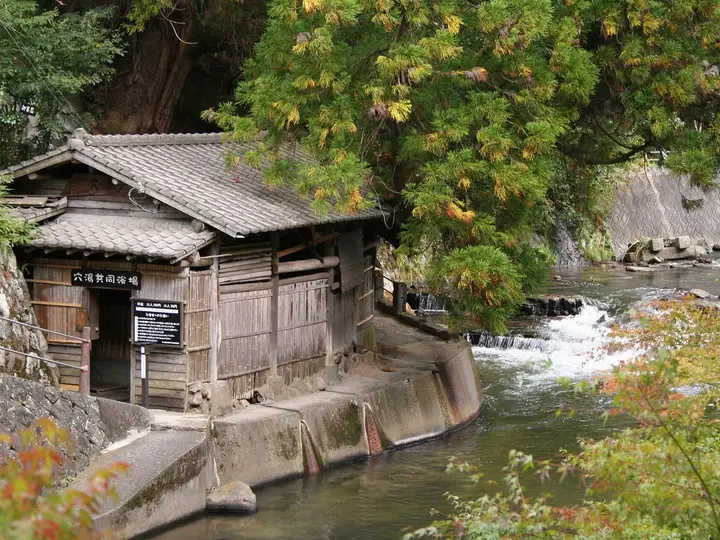
Sunamushi Kaikan Saraku
Near Ibusuki, Kagoshima Prefecture, Japan
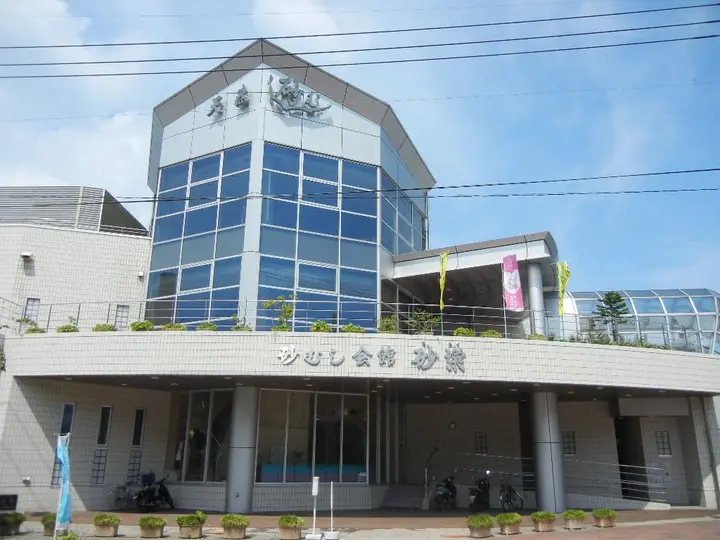
Ibusuki's public sand-bath hall on Surigahama beach. You pay, change into a rented yukata, and staff shovel hot spring-heated sand over you, then you rinse off in the indoor bath.
Photos: BirdsEyeLV (CC BY-SA 3.0); Mamusi Taka (CC BY-SA 3.0). Resized and cropped for this page.


- Water temperature
- Not published
- Entry
- Paid
- Getting in
- Drive-up
- Type
- Public pool
- The cheapest sand-bath plan is ¥1,500 for adults and covers the rented yukata, the burial and the indoor hot spring bath.
- Burials normally take place under a roofed shelter on the beach, so the sand bath runs in the rain.
- On calm spring-tide low tides staff may move the burial down to the open shore.
- A 10-visit sand-bath ticket costs ¥9,300 for adults, for people staying a while in Ibusuki.
What to expect
Sunamushi Kaikan Saraku is the public sand-bath hall in Ibusuki, at the southern tip of the Satsuma Peninsula in Kagoshima. It stands on Surigahama, the stretch of beach where hot spring water rises through the shore, and it is the place most day visitors go to try sunamushi, the local sand bath. The name “Saraku” is written with the characters for sand and pleasure.
This page covers the hall itself: how a visit works, what each plan includes and what the rules are. For the wider spa town, the geology of the beach and the hotels that run their own sand baths, see our Ibusuki Onsen guide.
A sand bath is not a soak. You lie on your back in a cotton yukata while staff dig a shallow trench, then shovel damp, dark volcanic sand over you up to the neck. The heat comes from the hot spring below. It is heavy and hot, and within about 10 minutes most people are sweating hard. When you have had enough you sit up, shake off, walk back to the building and wash in the indoor hot spring bath.
How the sand bath works
- Queue and pay. Take a number on arrival. Reception is on the second floor, up the escalator. Pick a plan and collect a yukata in your size. Extra-large and extra-extra-large sizes are available.
- Change. Shoes go into a plastic bag in the bottom locker in the changing room. Put on the yukata, and the rented inner garment if your plan includes one, and nothing else. Take your locker key and the souvenir towel, which you wrap around your head on the sand.
- Walk down to the beach. Men and women leave from separate changing rooms, step outside, turn right and go down a flight of steps to the sand area. Sandals are provided, and you may bring your own if the provided ones are hard to walk in. Tell staff in advance if steps are difficult for you.
- Get buried. Staff take over here. They choose your spot, help you lie down and cover you. Say at once if it gets too hot; they can take sand off.
- Rinse and bathe. Back at the building, return the sandals to the case outside and drop the yukata and inner garment at the return window. Shower off every grain of sand (toes, back and neck are the usual places it hides), then wash before you get into the hot spring.
Normally the burial happens in a roofed, all-weather area on the beach. On low tides, above all spring tides on good-weather days, staff may move it down to the waterline. Saraku links a tide table on its site, but whether the beach is used is decided on the day.
The water
Saraku’s hot spring is a sodium chloride (salt) spring. The operator gives its pH as 7, against 8.2 for sea water, with chloride at 7,000 mg per litre (about a third of sea water) and sulphate at 400 mg per litre (about a fifth). It tastes faintly salty. Springs on the shore here reach about 176°F80°C, and Saraku says digging a few metres down almost anywhere in this part of town hits hot water.
The operator promotes sand bathing with a 1985 Kagoshima University study of heart rate and body temperature during a burial. We do not repeat its health claims. Saraku does not say whether the indoor bath water is heated, circulated or chlorinated.
Prices and booking
All plans include the indoor bath. Adults are junior high age and up; children are elementary age and under. Prices are from Saraku’s site in October 2026.
| Plan | Includes | Adults | Children |
|---|---|---|---|
| Minimum set | Sand bath, bath, rented yukata | ¥1,500 | ¥800 |
| Towel set | Above + souvenir towel | ¥1,800 | ¥1,100 |
| Saraku set | Above + rented bath towel | ¥2,100 | ¥1,400 |
| Inner set | Saraku set + rented inner garment | ¥2,600 | ¥1,900 |
| Indoor bath only | No sand bath, no yukata | ¥800 | ¥400 |
Add-ons: souvenir towel ¥300, rented bath towel ¥300, rented inner garment ¥500. With a disability certificate, the minimum set is ¥750 (¥400 for children) and the indoor bath ¥400 (¥200). Groups of 20 or more pay ¥1,200 per adult and ¥600 per child. A 10-visit sand-bath ticket costs ¥9,300 (¥5,200 for children) and a 10-visit bath-only ticket ¥6,100 (¥3,000); these are for one person and cannot be shared.
Special rates apply in holiday periods. In the April 2026 to March 2027 business year they are April 29 to May 6, August 11 to 16, September 19 to 23, and December 29, 2026 to January 3, 2027.
Saraku accepts major credit cards, transit IC cards such as Suica and SUGOCA, iD and QUICPay, and QR payments including PayPay, Alipay and WeChat Pay.
Rules and etiquette
- No phones or cameras. You cannot bring them into the sand area, the changing rooms or the baths, and that applies to companions who are not bathing too. Saraku sells a photo service taken by its own staff.
- Yukata only. No swimsuits, own clothes or underwear under the yukata.
- Tattoos are allowed. Keep them covered by the yukata on the sand, and cover them as far as possible in the indoor bath.
- Wash before the bath. The indoor baths are gender-split and you bathe naked, as in any Japanese public bath.
- Lockers are paid and are inside the changing rooms.
Facilities
The indoor bathing area has the sodium chloride hot spring bath, a hot spring sauna and a dry sauna. Our Ibusuki Onsen guide notes that shampoo, body soap and free hair dryers are provided. On the third floor, the hall’s restaurant serves lunch from 11:00 to 15:30 and closes on Wednesdays. The second floor has a souvenir shop, there are drink vending corners on the first and second floors, and benches on the first floor for companions who are waiting.
Getting there
Saraku is at 5-25-18 Yunohama, Ibusuki (phone 0993-23-3900).
- By train: take the JR Ibusuki Makurazaki Line from Kagoshima-Chūō Station to Ibusuki, about an hour. From the station it is about 20 minutes on foot or 5 minutes by taxi.
- By bus: local buses from central Kagoshima take about 1 hour 30 minutes and stop at “Sunamushi Kaikan-mae” outside the door. The airport bus from Kagoshima Airport to Ibusuki Station takes about 2 hours.
- By car: about 1 hour 35 minutes from Kagoshima Airport, or 10 minutes from Ibusuki IC on the Ibusuki Skyline. The free car park holds about 90 cars and can fill at busy times.
When to go
Weekday mornings are the easiest time. On weekdays the sand bath stops taking people from 12:00 to 13:00; weekends and holidays run straight through. Expect queues and higher prices in Golden Week, Obon and New Year. Saraku closes for about a week of maintenance each July and December (December 14 to 18 in 2026) and in severe storms, which matters in the late-summer typhoon season.
Where to stay nearby
Saraku has no rooms. Ibusuki’s hotels line the coast south of the station around Surigahama, and several have their own sand baths. Lake Ikeda is about 15 minutes away by car and Mount Kaimon about 30 minutes. Kirishima Onsen, in the north of the prefecture, makes a good second Kagoshima stop.
Safety notes
- Heat: the sand is hot and heavy. Speak up early if you feel faint or too hot, and drink water afterwards.
- Health: Saraku’s FAQ lists conditions for which it asks people not to use the sand bath, including heart and blood-pressure problems, fever and pregnancy. Check with your doctor first if you have a chronic condition.
- Children: they must be able to say clearly when it is too hot. In the indoor bath, Kagoshima rules let children up to age 6 go in with a parent of the other sex.
- Footing: the outdoor steps to the sand get slippery in rain.
Map and nearby springs
GPS: 31.22979, 130.65191
Sunamushi Kaikan Saraku: common questions
How much does Sunamushi Kaikan Saraku cost?
The minimum set (sand bath, indoor bath and rented yukata) is ¥1,500 for adults (junior high and up) and ¥800 for elementary age and under. The towel set is ¥1,800 / ¥1,100, the Saraku set with a rented bath towel ¥2,100 / ¥1,400, and the inner set with a rented under-layer ¥2,600 / ¥1,900. The indoor bath alone is ¥800 / ¥400. Prices rise in Golden Week, Obon, Silver Week and New Year (2026 figures).
Do I need to book the Ibusuki sand bath?
No, and you cannot. Saraku runs a numbered queue on arrival and posts the current wait on its website. When the wait gets very long it may stop taking sand-bath visitors early. Groups of 20 or more should contact the hall ahead by phone or fax.
How long does a visit take?
Saraku suggests about an hour in total, including changing, the burial, rinsing off and a soak. Most people are sweating heavily within about 10 minutes under the sand.
What do I wear in the sand bath?
Only the rented yukata. Saraku asks you not to wear your own clothes, underwear or swimsuit underneath. If you want a layer, the inner set includes a rented under-garment, or you can add one for ¥500. The indoor baths afterwards are split by gender and you bathe naked.
Is the sand bath open when it rains?
Yes. The burial normally happens under a roofed, all-weather shelter on the beach. Saraku closes only in severe weather or if equipment fails. The short walk between the building and the sand is outdoors, so take care on the steps in wind and rain.
Can children and tattooed visitors use Saraku?
Children can try it from about age 2 or 3, as long as they can tell staff when they are too hot. Tattoos are allowed if the yukata covers them in the sand area, and Saraku asks you to cover them as far as possible and keep your soak short in the indoor bath.
Closest hot springs to Sunamushi Kaikan Saraku
Ibusuki Onsen (Sunamushi Kaikan Saraku)
Kagoshima Prefecture, Japan
0 mi away, ~10 min drive
Temp n/a Paid Drive-up
108°F42°C
Resort or spa
Near Takachiho
Public pool
Takachiho Onsen (Takachiho no Yu)
Miyazaki Prefecture, Japan
110 mi away, ~3 hr drive
Temp n/a Paid Drive-up