Sarıkaya Roman Bath (Basilica Therma, Kral Kızı Hamamı)
Near Sarıkaya, Yozgat, Turkey
A 2nd-century Roman bath in the centre of Sarıkaya, Yozgat, where 118°F48°C spring water still fills a marble pool. It is a protected archaeological site to look at, and we found no sign that visitors may bathe.
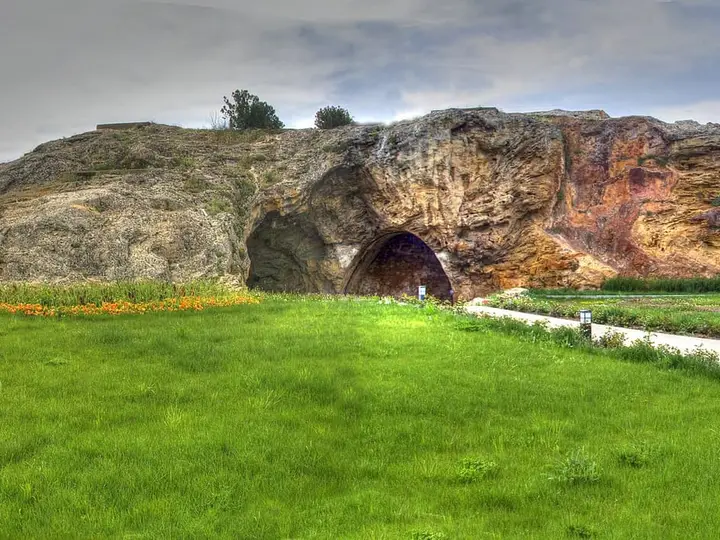
Photo: Seraksin (CC BY-SA 4.0). Resized and cropped for this page.

- Water temperature
- 100-104°F38-40°C
- Entry
- Free
- Getting in
- Drive-up
- Type
- Public pool
- Built on the spring itself around the mid-2nd century AD, with a 30 m marble facade still standing.
- The main pool measures about 23.3 by 12.8 m and has a cross-carved Byzantine baptismal stone in the middle.
- On UNESCO's World Heritage Tentative List since 2018; about 50,000 people visited in 2025.
- A municipal tea garden, gift shop and new lighting opened around the ruins in 2026.
What to expect
Most hot springs in this guide are places to get in the water. This one is different. The Sarıkaya Roman Bath is a Roman building that still sits on its own hot spring, in the middle of a small town on the Bozok plateau in central Anatolia. Water still runs into the old pool. You come to see it, walk around it and sit with a tea beside it.
The Ministry of Culture and Tourism lists the site as one of the few Roman-era thermal baths built in Anatolia, and the bath was designed to use the hot water straight from the ground. What survives is a long marble building, about 30 m long and 4.5 m high, with a decorated west facade that looks like a nymphaeum, the ornamental fountain front of a Roman town. The Ministry dates it to around the middle of the 2nd century AD from its decoration and finds.
In front of the arches lies the big pool. Its visible size is roughly 23.3 by 12.8 m, with a depth of 1.34 m and a marble floor that has buckled in places. In the middle sits a two-piece stone, about 120 by 140 cm, carved with a cross in a circle. It is thought to be a baptismal font from the Byzantine period, when a church was added and the town became a bishop’s seat. At each end of the building, excavators found a semicircular pool, and one room with the stone supports of an underfloor heating system.
The water is the reason anyone built here. The Ministry gives the spring as a fluoride-bearing water at 118°F48°C, flowing at 28 litres a second, and says it settles to 100-104°F38-40°C. News reports round it to about 122°F50°C. On a cold morning the pool steams.
Since 2026 the site has felt more like a town square than a dig. The municipality runs a tea garden and gift shop alongside, walking paths circle the ruins, and new lighting opened the bath to evening visitors in autumn 2026. Daily Sabah reported about 50,000 visitors in 2025.
Can you bathe here?
Plan on not bathing. The bath is a registered cultural property and, since 2013, a protected archaeological site. The Yozgat Museum Directorate supervised the 2022-2024 landscaping. Neither the Ministry’s own site card nor any of the 2026 news coverage we read says visitors may enter the pools, and the Ministry describes them as excavated remains rather than a working bath. Sözcü reported that thermal water, cut off for about two years, has been fed back into the pool. That is about keeping the monument alive, not about reopening it for swimmers.
If you want a soak in central Anatolia, combine a visit here with one of the working spas listed below.
Getting there
Sarıkaya is a district town in the southeast of Yozgat Province. The Ministry places the bath in the town centre, about 77 km (48 miles) southeast of Yozgat city, on the main road that links the Black Sea coast with the Mediterranean. The address is Kaplıca Mahallesi, Mimar Sinan Caddesi.
- By car from Yozgat: Take the main road southeast toward Sarıkaya, about 77 km (48 miles). In town, head for the Kaplıca neighbourhood and Mimar Sinan Caddesi.
- By bus: We found no published timetable. Ask at the Yozgat bus station for minibuses to Sarıkaya.
- On foot in town: The bath is in the centre, so once you are in Sarıkaya you can walk to it.
There is no long approach and no trail. You see the ruins from the edge of the site.
When to go
The site is open in every month of the year, according to Sözcü. Daily Sabah reported in June 2026 that visitor numbers climb as the weather warms. Sarıkaya stands at about 1,170 m, so winters are cold and snowy; NTV ran pictures of the ruins under snow. That can be the best time to see steam rising from the pool, but dress for it.
From autumn 2026, evening visits are possible under the new lighting. Summer evenings, with a tea at the café beside the ruins, are a good time to come.
Rules and etiquette
- Fee: The Ministry site card lists the ruins as free.
- Hours: Not published. The Ministry card shows blank opening times, so check with the Yozgat Museum Directorate before a long drive.
- Do not climb on the ruins. This is a protected site. Stay on the paths and keep off the marble edges and walls.
- Do not enter the pools unless staff on site tell you otherwise.
- Ask before flying a drone. It is a protected site, and we found no published drone policy.
Bathing culture
The building tells the history of bathing in Anatolia in one place. It was a Roman bath first. After Christianity spread, a church was added to the north side and the big pool took on a baptismal role. The Ministry notes that Christian sources place Saint Peter on the road through Basilica Therma between Sebasteia (Sivas) and Mazaka (Kayseri). After 1071 the region passed through Danishmend, Seljuk, Eretna and other hands before the Ottomans arrived in 1521. Under the Ottomans the settlement around the spring was called Ilısu, and later Hamam Köyü, “bath village”. Early Republican sources call it the Terzili Hamamı. Through all of that, people kept using the hot water.
If you go on to a working Turkish kaplıca (thermal bath), the rules are much the same across the country. Men and women usually bathe in separate halls, or families rent a private cabin. Wrap a peştamal, a thin cotton cloth, around your waist or wear a swimsuit. Rinse before you enter a pool, keep soap out of it, and scrub off at the basins with a kese mitt. Keep your voice low.
Where to stay nearby
There is no lodging at the site. Sarıkaya is a small district town, so check what is open before you rely on it. Yozgat city, 77 km (48 miles) to the northwest, is the provincial capital and the main base for the area.
Nearby stops worth adding
For a working soak in the same part of Turkey, the closest listings in this guide are east in Sivas Province and further southeast:
- Kangal Balıklı Kaplıca, the fish spring in Sivas Province.
- Çermik Thermal Springs, in Diyarbakır Province.
Safety notes
- Hot water: The spring leaves the ground at about 118°F48°C. That is hot enough to scald. Do not test it with a foot.
- Slippery marble: Wet marble and uneven paving around the pool are slick, especially in frost.
- Open excavation: Some walls and edges have no railings. Watch children near the pool rim.
- Winter: At 1,170 m, snow and ice are normal in winter. Drive carefully on the main road and bring warm layers for an evening visit.
Map and nearby springs
GPS: 39.49492, 35.37631
Sarıkaya Roman Bath (Basilica Therma, Kral Kızı Hamamı): common questions
Can you swim or bathe in the Sarıkaya Roman Bath?
Plan on looking, not soaking. The pools are part of a registered archaeological site supervised by the Yozgat Museum Directorate. Neither the Ministry's site card nor any 2026 report we read says bathing is allowed, and the Ministry describes the pools as excavated remains. Ask the staff on site, but do not count on getting in.
How hot is the water at the Roman bath in Sarıkaya?
The Ministry of Culture and Tourism gives the spring at 118°F48°C with a flow of 28 litres a second, and says it cools to 100-104°F38-40°C once it settles. News reports round the source to about 122°F50°C.
Is there an entry fee for the Sarıkaya Roman Bath?
The Ministry's site card lists it as free. It publishes no opening hours, so if you are coming a long way, check with the Yozgat Museum Directorate before you set off.
Why is it called Kral Kızı (the King's Daughter)?
Local legend says the daughter of a king from Kayseri was cured of an illness after bathing here. Historians know the place as Aquae Saravenae in Roman sources and Basilica Therma in the Byzantine period.
Where is the Sarıkaya Roman Bath?
In the middle of Sarıkaya, a district town about 77 km (48 miles) southeast of Yozgat city, on Mimar Sinan Caddesi in the Kaplıca neighbourhood. You can walk to it from the town centre.
Closest hot springs to Sarıkaya Roman Bath (Basilica Therma, Kral Kızı Hamamı)
Near Kozaklı
Resort or spa
Kozaklı Thermal Springs (Kozaklı Kaplıcaları)
Nevşehir, Turkey
34 mi away, ~55 min drive
Temp n/a Paid Drive-up
Terme Kaplıcası (Kırşehir Terme Thermal Springs)
Kırşehir, Turkey
70 mi away, ~2 hr drive
Temp n/a Paid Drive-up
99-100°F37-38°C
Resort or spa
Hamamayağı Thermal Springs (Hamamayağı Kaplıcası), Ladik
Samsun, Turkey
104 mi away, ~2.5 hr drive
99-100°F37-38°C Paid Drive-up
Kangal Balıklı Kaplıca (Kangal Fish Spring)
Sivas, Turkey
112 mi away, ~3 hr drive
95-99°F35-37°C Paid Drive-up
Near Haymana
Public pool
Haymana Thermal Springs (Haymana Kaplıcaları)
Ankara, Turkey
154 mi away, ~4 hr drive
Temp n/a Paid Drive-up
90°F32°C
Public pool
Haruniye Thermal Springs (Haruniye Kaplıcaları)
Osmaniye, Turkey
158 mi away, ~4 hr drive
90°F32°C Paid Drive-up
Sources we checked (6)
- muze.gov.tr/muze-detay
- en.wikipedia.org/wiki/Basilica_Therma
- dailysabah.com/life/travel/2000-year-old-roman-bath-in-turkiye-welcomes-visitors-after-dark/amp
- dailysabah.com/life/travel/roman-baths-in-central-turkiye-see-surge-in-tourist-interest/amp
- sozcu.com.tr/dunyada-sadece-iki-tane-var-yozgat-taki-bu-tarihi-yapi-gorenleri-buyuluyor-p176147
- haberturk.com/termal-suyun-2-bin-yildir-aktigi-kral-kizi-ziyaretcilerini-agirliyor-3890404