Longmire Mineral Springs
Near Ashford, Washington, United States
Cold and lukewarm soda springs in a meadow at Longmire, Mount Rainier National Park, where James Longmire ran a mineral springs resort from 1890. A 0.7-mile loop passes the springs. You cannot soak.
Photo: Mount Rainier National Park from Ashford, WA, United States (CC BY 2.0). Resized and cropped for this page.

- Water temperature
- Not published
- Entry
- Paid
- Getting in
- Short walk
- Type
- Public pool
- The National Park Service says you cannot soak in the springs today, and drinking the water is not advised.
- The Trail of the Shadows is an easy 0.7-mile loop that starts across the road from the National Park Inn.
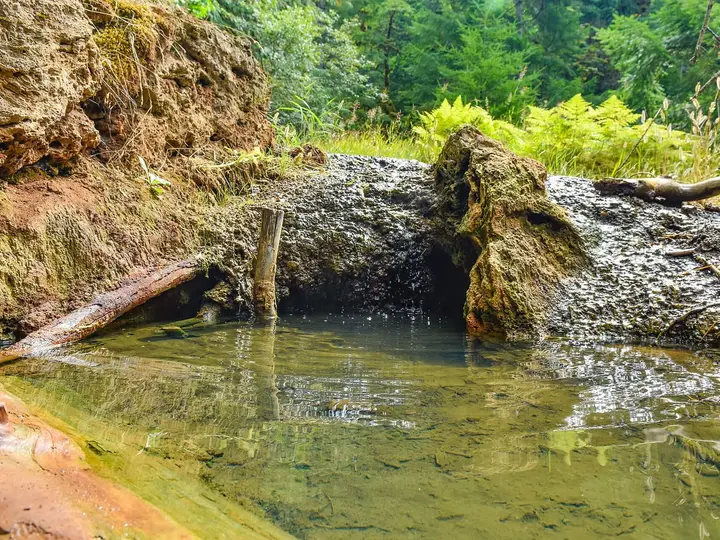
- Look for carbon dioxide bubbles, rust-red iron stains, pale travertine and the enclosed spring called Iron Mike.
- Longmire is 6.5 miles inside the Nisqually Entrance and open all year, with a museum, the National Park Inn and a restaurant.
What to expect
Longmire is where Mount Rainier National Park began as a destination, and the mineral springs are the reason. The springs rise in Longmire Meadow, a small wet clearing below Rampart Ridge, 6.5 miles inside the Nisqually Entrance. NPS says volcanic mineral springs created the meadow in the first place.
These are not hot springs in the soaking sense. The National Park Service says water from snowmelt and rain high on the mountain seeps down and is heated by magma deep underground. It then rises through cracks, mixing with cold shallow groundwater on the way, so what reaches the surface ranges from cold to lukewarm. NPS calls them soda springs, rich in sodium bicarbonate (baking soda). An exhibit panel on the trail is direct about the rules: you cannot soak in the springs today, and drinking the water is not advised.
What you can do is look, listen and smell. NPS suggests watching for carbon dioxide bubbles, which slow down when the water table drops in dry spells. The rotten-egg smell is hydrogen sulfide gas. Pale brown patches of bare ground are travertine, and the rust-red streaks are iron oxidizing as it meets the air. The panel challenges you to count how many separate springs you can find along the way. The best-known one, an enclosed spring next to the trail, has long been called “Iron Mike.”
History
James Longmire came across the springs in 1888, by the park’s account, while on a climb of Mount Rainier. He filed a placer mining claim to hold the land, and in 1892 received a patent for 18.2 acres that took in the meadow and most of its springs. In 1890 the family opened the Longmire Medical Springs Resort, which NPS compares to a modern health spa. Guests rode in on horseback, paid for room and board plus spring treatments, and were urged to soak in the springs or take a sulfur plunge bath. Massages and rubs were house specialties. An 1890 Tacoma newspaper advert claimed the water could cure rheumatic pains.
Elcaine and Martha Longmire ran the resort in its busiest years in the early 1900s and added cabins, tents and bathhouses. The family sold the property in 1920, and the old hotel was torn down and burned. The 1888 Elcaine Longmire cabin still stands beside the trail.
Getting there
Longmire is on the Nisqually to Paradise road in the southwest corner of the park.
- From Seattle or Tacoma: head south to SR 7 and then SR 706 east through Elbe and Ashford to the Nisqually Entrance. Longmire is 6.5 miles past the entrance.
- Parking: use the main Longmire lot by the National Park Inn and the Longmire Museum.
- The walk: the Trail of the Shadows starts across the road from the National Park Inn. It is an easy 0.7-mile (1.1 km) loop around the meadow. The homestead cabin and Iron Mike are near the start of the loop, so even a very short walk gets you to the springs.
A note for big vehicles: the Nisqually Suspension Bridge near Longmire has a 3-ton limit. NPS says RVs, trailers and some heavy trucks and SUVs must park in the main Longmire lot and cross on foot.
When to go
Longmire is open year-round. The museum is usually open daily all year, and the National Park Inn and its restaurant usually stay open all year as well. The Wilderness Information Center is usually open from late May to early October.
Summer and early fall are the easy months. Mornings and evenings are the quietest times in the meadow and the best for spotting deer and birds. In winter the trail can be under snow, and the road above Longmire to Paradise closes every night. Check the park’s road status page before you drive up in winter, and carry chains.
Rules and etiquette
These are Mount Rainier National Park rules:
- Entrance fee (2026): $30 per private vehicle for seven days, $25 per motorcycle, $15 per person on foot or bicycle, or $55 for a park annual pass. Passes are sold by card or electronic payment only; the park does not accept cash at entrances. If you only have cash, NPS lists Ashford businesses that sell the $30 vehicle pass in advance.
- No timed entry in 2026. The park says it will not require timed-entry reservations anywhere this year.
- No soaking, and do not drink the water. Stay on the trail so you do not trample the springs or the wet meadow.
- Pets are not allowed on park trails, including this one. They may go in parking lots, campgrounds and on paved roads open to vehicles, on a leash no longer than 6 feet.
Where to stay nearby
- National Park Inn, right at Longmire, is a concessioner-run hotel with a restaurant and gift shop, usually open all year.
- Cougar Rock Campground, further up the road in the southwest corner of the park, has 178 individual sites at $20 a night and is usually open from late May to late September. It was closed for the 2026 season by mid-October. Reserve on Recreation.gov.
- Ashford, just outside the Nisqually Entrance, has lodges, cabins and places to eat.
Mount Rainier also has another historic spring site, Ohanapecosh Hot Springs, on the southeast side of the park. It is covered in its own listing. Ohanapecosh Campground is closed for all of 2026 for a rehabilitation project.
Safety notes
- Wet ground: the meadow is boggy around the springs, and the mineral crusts can be slick. Stay on the trail.
- Gas: carbon dioxide and hydrogen sulfide come off the springs in small amounts. In open air this is not a hazard, but do not put your face into hollows over the water.
- Winter driving: the road above Longmire can be icy and closes nightly in winter. Snowplows run on park roads, so walking on them is unsafe in winter.
- Wildlife: keep your distance from deer and black bears, and never feed animals.
Map and nearby springs
GPS: 46.75285, -121.81311
Longmire Mineral Springs: common questions
Can you soak in the Longmire mineral springs?
No. An NPS exhibit panel on the Trail of the Shadows states plainly that you cannot soak in the springs now. The Longmire family once ran a resort where guests soaked and took plunge baths, but that ended about a century ago. The springs are for looking at only, and NPS also advises against drinking the water.
How long is the Trail of the Shadows?
It is a 0.7-mile (1.1 km) loop around Longmire Meadow, rated easy by NPS and open year-round. It passes the old Longmire homestead cabin and several mineral springs, and a short spur leads into the meadow for views of Mount Rainier and Rampart Ridge.
Do you need a reservation to visit Longmire?
No. Mount Rainier National Park says timed-entry reservations are not required anywhere in the park and will not be used in 2026. You do need an entrance pass, which costs $30 per private vehicle for seven days. The park is cashless.
Are the Longmire springs hot?
Not really. NPS says the water is warmed deep underground and then mixes with cold shallow groundwater before it rises, and it describes some springs as warm and others as cold. None of them is a hot soaking pool.
Can I bring my dog on the Trail of the Shadows?
No. Pets are not allowed on any trail in Mount Rainier National Park except the Pacific Crest Trail on the east side. At Longmire, leashed pets may stay in parking lots and on paved roads open to vehicles.
Closest hot springs to Longmire Mineral Springs
104-111°F40-44°C
Resort or spa
Goldmyer Hot Springs
Washington, United States
54 mi away, ~1.5 hr drive
104-111°F40-44°C Paid Long hike
Near Carson
Wild & natural
104°F40°C
Resort or spa
Near Stevenson
Resort or spa
All hot springs in WashingtonAll hot springs in United StatesOpen the full map
Sources we checked (6)
- nps.gov/mora/planyourvisit/longmire.htm
- nps.gov/places/trail-of-the-shadows-nature-s-own-laboratory-exhibit-panel.htm
- nps.gov/places/trail-of-the-shadows-rusty-springs-exhibit-panel.htm
- nps.gov/places/trail-of-the-shadows-nature-s-spa-exhibit-panel.htm
- nps.gov/mora/planyourvisit/fees.htm
- nps.gov/mora/planyourvisit/pets.htm