Therma Samothraki (Loutra Thermal Baths)
Near Therma (Loutra), Samothraki, Greece
A municipal bathhouse with separate men's and women's pools at 100-106°F38-41°C and 13 private tubs, plus small free open-air pools, in the plane-shaded village of Therma on Samothraki's north coast.
Photo: DocWoKav (CC BY-SA 4.0). Resized and cropped for this page.

- Water temperature
- 100-106°F38-41°C
- Entry
- Paid
- Getting in
- Drive-up
- Type
- Public pool
- The men's pool runs at 104-106°F40-41°C and the women's at 100-102°F38-39°C; there are also 13 private tubs.
- The bathhouse keeps late hours in season, reopening in the evening until about 23:45.
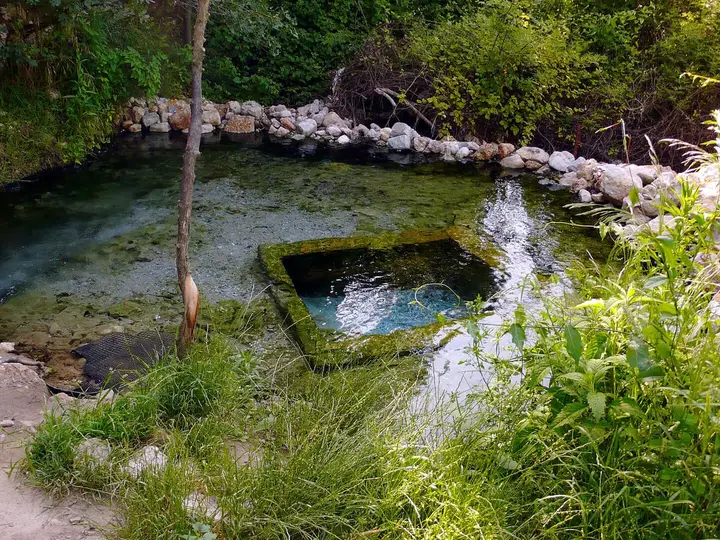
- Free open-air hot pools sit a short walk uphill from the bathhouse.
- Therma is the starting point for the cold-water vathres (rock pools) of Gria Vathra and Fonias, and for the climb up Mount Saos.
What to expect
Therma, also called Loutra (“the baths”), is a small village on the north coast of Samothraki, about 600 m (0.4 miles) inland from the sea at the foot of Mount Saos. It is the island’s main base for walkers and swimmers: plane trees, walnut and chestnut shade, a handful of tavernas and rooms, and streams that pour off the mountain into cold rock pools. The hot springs are at the entrance to the village, at the foot of the hill known as Psarothermi.
There are two ways to soak here.
- The municipal bathhouse (Dimotiko Ydrotherapeftirio), built in 1981, is the main facility. It has two indoor pools, one for men and one for women, and 13 private bathtubs. This is a plain, functional building where locals and older visitors come for a course of baths, not a spa.
- The open-air pools are a pair of small hot basins a short walk uphill from the bathhouse, in the part of the village called Loutra. They are free, unstaffed and open at any hour.
The water
The spring is very hot: the regional spa guide gives a source temperature of around 212°F100°C, and the water is cooled before it reaches the baths. Inside, the guide gives 104-106°F40-41°C for the men’s pool and 100-102°F38-39°C for the women’s pool. It describes the water as a weakly radioactive, mineral-rich chloride spring with sodium, calcium, potassium, boron, bromine and iodine, and the village smells of sulphur.
The bathhouse markets the water for rheumatic conditions, arthritis, some gynaecological complaints, circulation problems and skin conditions. We make no claims for it.
The open-air pools vary. Their temperature depends on how much hot water is running in, so test before you get in.
Getting there
Samothraki has no airport. You arrive by sea at Kamariotissa, the island’s port on the north-west coast.
- From Alexandroupoli: Ferries run all year, normally daily, and take under 2 hours. Most leave Alexandroupoli in the morning. Book ahead for a car in July and August.
- From Lavrio (Athens): Summer only, about 15 hours, with no fixed schedule.
- From Kavala: Occasional summer sailings.
From Kamariotissa, drive east along the north coast road for about 15 km (9 miles) to Therma. Chora, the island capital, is about 12 km (7.5 miles) away. KTEL Evrou buses run along the coast and stop in the village square by the cafes. The bathhouse is at the entrance to the village, right by the road, with parking nearby.
When to go
- June and September are the best months. The bathhouse is open, the cold vathres are swimmable, and the village is busy but not packed.
- July and August are the busiest months on the island, and the small free pools fill up quickly.
- October is quiet, and the bathhouse usually closes at the end of the month.
- Winter closes the bathhouse and many rooms and tavernas. The open-air pools keep running, and the Alexandroupoli ferry still sails.
Rules and etiquette
- Bathhouse: Pay at the door and take cash. Men and women use separate pools. Bring a swimsuit and ask the attendant what is expected, and shower before you get in. Ask at the desk for a private tub.
- Open-air pools: These are mixed and outdoors, so wear a swimsuit. No soap, shampoo or glass. Do not dam or redirect the hot water.
- Pack out what you bring. The free pools have no bins or staff.
- Keep out of fenced or signed work areas. After the August 2026 accident, the mayor repeated the request to follow safety signs and stay away from places where works are going on.
We found no published rules on children in the bathhouse. If you are travelling with kids, ask at the desk; the water in the men’s pool is too hot for small children in any case.
Where to stay nearby
Therma has the most rooms on the north coast.
- The village has pensions, small hotels and apartments, many within a few minutes’ walk of the baths and the vathres.
- The municipal campsite at Therma is run by the Municipality of Samothraki in summer and is the base for many hikers.
- Kamariotissa, 15 km (9 miles) west, has the port, more hotels and car and scooter hire.
- Chora, inland, has more rooms.
Book well ahead for July and August; the island fills up.
Safety notes
- Open boreholes and very hot pipes. The spring water is close to boiling at source. In August 2026 a 22-year-old fell into an open, unguarded borehole near the baths at night and suffered burns over a large part of his body. Carry a torch after dark, stay on paths, and never step into a hole or channel that is steaming.
- Test the water. The open-air pools can run much hotter than the bathhouse pools when fresh water is flowing in. Put a hand in first.
- Short soaks. At 104-106°F40-41°C, keep to 10 to 15 minutes, drink water and get out if you feel dizzy.
- Medical care. Serious injuries are moved off the island by Coast Guard boat to Alexandroupoli. Bring any medicines you need.
- The vathres. The cold rock pools above Therma are slippery, and the passage beyond the third pool at Gria Vathra beside the waterfall needs experience. Do not jump into pools you have not checked.
Nearby stops worth adding
The cold-water vathres are the reason most people come to Therma. Gria Vathra, reached on a path from the village through ferns and plane trees, has three easy pools before the trail gets difficult. The Fonias gorge, signposted east of Therma, reaches its first waterfall and big pool after about 30 minutes of easy walking. Mount Saos, about 1,600 m (5,250 ft) high, is climbed from Therma on a hard route of about 8 km (5 miles), around 6 hours to the top.
The Sanctuary of the Great Gods at Palaiopoli, west of Therma, is the island’s main archaeological site.
Back on the mainland, the Traianoupoli thermal baths are about 14 km (9 miles) east of Alexandroupoli, an easy stop before or after the ferry.
Map and nearby springs
GPS: 40.49763, 25.60307
Therma Samothraki (Loutra Thermal Baths): common questions
Are the hot springs at Therma free?
Partly. The municipal bathhouse charges for its pools and private tubs. OpenStreetMap mappers recorded €4 for the pool and €6 for a private bath, but the municipality does not publish a price list online, so take cash and check at the door. The two small open-air pools a short walk uphill are free and open at any hour.
How hot is the water at the Therma baths?
The spring comes out of the ground at close to 212°F100°C and is cooled before it reaches the baths. The regional spa guide gives 104-106°F40-41°C for the men's pool and 100-102°F38-39°C for the women's pool.
When is the Samothraki bathhouse open?
From June to October. The regional spa guide gives two sessions a day, 07:30 to 13:30 and 17:30 to 23:45. Hours can change from year to year, so check in the village. The open-air pools have no hours.
Was someone hurt at the Samothraki hot springs in 2026?
Yes. On the night of 2 August 2026 a 22-year-old visitor fell into an open, unguarded borehole carrying hot spring water in the baths area and was flown to a burns unit in Thessaloniki. The mayor asked residents and visitors to obey safety signs and keep out of areas where works are going on. Use a torch after dark and stay on paths.
How do you get to Therma on Samothraki?
Take the ferry from Alexandroupoli to Kamariotissa, which takes under 2 hours and runs all year. Therma is about 15 km (9 miles) east of the port along the north coast road. KTEL Evrou buses stop in the village.
Closest hot springs to Therma Samothraki (Loutra Thermal Baths)
97-99°F36-37°C
Public pool
Traianoupoli Thermal Baths (Loutra Traianoupolis)
Evros, Greece
34 mi away, ~55 min drive
97-99°F36-37°C Paid Drive-up
Near Ezine
Resort or spa
Kestanbol Kaplıcaları (Alexandria Troas Kestanbol Thermal Springs)
Çanakkale, Turkey
61 mi away, ~1.5 hr drive
Temp n/a Paid Drive-up
Eftalou Hot Springs (Bathhouse)
Lesbos, Greece
84 mi away, ~2 hr drive
109-115°F43-46°C Paid Short walk
Near Edremit
Resort or spa
Güre Thermal Springs (Güre Kaplıcaları)
Balıkesir, Turkey
92 mi away, ~2.5 hr drive
Temp n/a Paid Drive-up
108°F42°C
Resort or spa
Polichnitos Hot Springs (Hippocrates Thermal Baths)
Lesbos, Greece
103 mi away, ~2.5 hr drive
108°F42°C Paid Drive-up
Sources we checked (6)
- allovergreece.com/Thermal-Spring/Descr/22/el
- el.wikipedia.org/wiki/%CE%98%CE%AD%CF%81%CE%BC%CE%B1_%CE%A3%CE%B1%CE%BC%CE%BF%CE%B8%CF%81%CE%AC%CE%BA%CE%B7%CF%82
- travel.gr/explore/samothraki-pliris-odigos-gia-to-pio-ain/
- athensvoice.gr/epikairotita/ellada/979093/samothraki-ektos-kindunou-o-nearos-pou-traumatistike-sta-iamatika-loutra/amp/
- dnews.gr/eidhseis/ellada/603334/samothraki-diasolinomenos-22xronos-me-egkaymata-sto-49-tou-somatos-tou-meta-apo-ptosi-se-geotrisi-thermon-neron
- ferryhopper.com/en/destinations/greece/samothraki