Pilgrim Hot Springs (Unaatuq)
Near Nome, Alaska, United States
A spring-fed pool and three cedar tubs on Native-owned land 60 miles from Nome, beside the ruins of a 1918 Catholic orphanage, open to permit holders in summer.
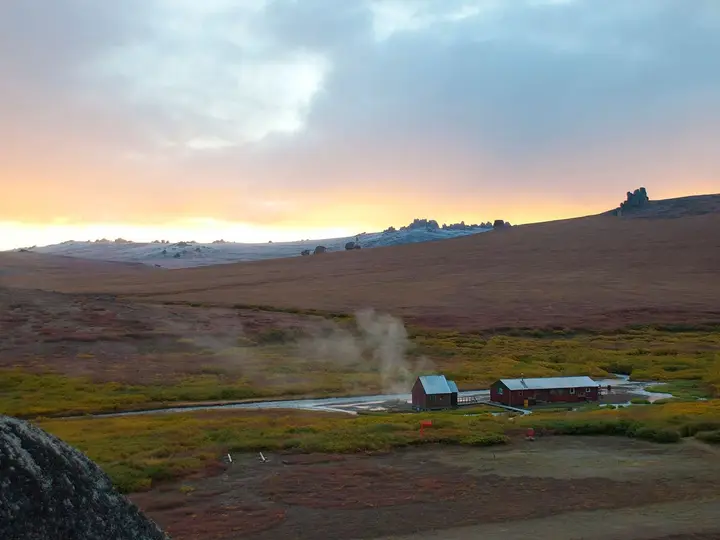
Photos: Dr. John Cloud, NOAA Central Library (Public domain); Bering Land Bridge National Preserve (CC BY 2.0). Resized and cropped for this page.


- Water temperature
- 105°F41°C
- Entry
- Free
- Getting in
- 4WD road
- Type
- Public pool
- The main pool usually runs about 105°F41°C, with a cooler shallow end, and three cedar tubs face the Kigluaik Mountains.
- The site is owned by Unaatuq, LLC, a group of Native corporations and tribes, and entry needs a free permit.
- Buildings from the 1918 Catholic mission and orphanage still stand, but you may only look at them from outside.
- All the land around the property belongs to Mary's Igloo Native Corporation, which sells its own permits.
What to expect
Pilgrim Hot Springs sits in a green pocket of willow and cottonwood on the Seward Peninsula, about 60 miles from Nome, where thawed ground around the springs lets trees grow in a landscape that is otherwise tundra. The Iñupiaq name is Unaatuq, which means warm waters. People soaked and gathered here long before the mining rush, and the site still matters to families across the Bering Strait region.
You soak in one main pool and three cedar tubs. The pool is fed from a well that brings water up at about 180°F82°C, and it normally sits around 105°F41°C, with a shallow section that tends to be cooler. The three cedar tubs went in during the summer of 2024 and look out at the Kigluaik Mountains. A changing shack built the same year sits near the tubs; change there before you get in.
The temperature is checked only in summer, when a caretaker lives on site, and the operators are frank that they cannot always control it. Test the water before you settle in.
Around the pools are the buildings of the old Catholic mission: a church, dormitory and other structures, some leaning badly. You may walk the grounds and look, but the buildings are closed because of collapse risk. There is also a 9-hole disc golf course (free if you leave an ID with the caretaker), walking paths to the farm sloughs and the Pilgrim River pump, and a garden.
Who runs it and the land rules
Pilgrim Hot Springs is owned by Unaatuq, LLC, a partnership of Native organizations from the region: Bering Straits Native Corporation, White Mountain Native Corporation, Mary’s Igloo Native Corporation, Kawerak, Inc., Sitnasuak Native Corporation, King Island Native Community and the Village of Solomon. Kawerak and Bering Straits Native Corporation handle day-to-day operations. The partnership bought the property in 2010 from the Catholic diocese.
This is private land, opened to the public on the owners’ terms. Two permits matter:
- The Pilgrim day pass. Everyone entering checks in, signs a liability waiver and holds a permit. In 2026 the day pass cost $0. Cabin and campsite guests have it included in their booking.
- The Mary’s Igloo Native Corporation (MINC) permit. MINC owns the land bordering the property and most of the country around it. If you only drive in on the access road or fly in, you do not need it. If you want to hike beyond the property boundary, cross from the river, or come in by any route other than the road, buy a MINC permit first (907-642-2308, migloonativecorp@gmail.com).
The operators ask visitors to stay on the road on the way in and to respect the tundra. Treat it as you would someone’s family land, because that is what it is.
Getting there
Nome is not on the road system. You fly in, usually on Alaska Airlines from Anchorage, and rent a vehicle in town.
From Nome, go two miles east on Front Street, then turn left (north) on Beam Road, which becomes the Kougarok Road. Around mile 53, look for an old yellow dozer and a green sign reading “Pilgrim Hot Springs 7 miles”, and turn left onto the gravel Pilgrim Road. Follow it 7 miles to the site. Park beyond the shipping containers by the far gate, leave the gate clear, and drive slowly on the property.
The Kougarok Road is gravel and dirt, with washboard, soft spots and long empty stretches. A high-clearance vehicle is the sensible choice. There is no cell service once you leave Nome, so carry food, water, a spare tire and an offline map.
In the off-season the site is cut off by road from roughly November to May. People do reach it by snowmachine or helicopter in winter, but the pool is not run for visitors then, and you should contact Kawerak before trying.
When to go
The season is short. The upper gate unlocks from mid-June, and the operators closed the 2026 season on September 27. Dates shift with weather, so check the website or call 907-331-4716 before booking flights to Nome.
July and August are the most reliable months: the road is usually at its best and the caretaker is there. Expect mosquitoes, long daylight and changeable weather.
Late August and September bring berries, fall color on the tundra and cooler soaking weather, with a growing chance of rain and early snow.
Day visitors may come from 10 a.m. to 10 p.m., every day except Tuesday. After 10 p.m. the pool and grounds are kept for overnight guests.
Rules and etiquette
- Check in and get your permit before you soak.
- Dogs are fine on a leash, but they must stay out of the bathing pools. Clean up after them.
- Camping only in the designated sites, and only as a paying guest.
- Trash goes in the bins provided, or pack it out.
- Historic buildings: look, photograph, but do not go inside.
- Disc golf: return the discs. An unreturned disc costs $10.
- The cemetery may be visited without a permit if that is the only reason you came. Be quiet and respectful there.
The operators do not publish a dress rule. This is a family and community place, so plan on a swimsuit.
Where to stay nearby
- On site: Unaatuq rents cabins and tent sites in summer. Check-in runs 3 to 10 p.m. and check-out is at noon. Prices are not posted online, so email pilgrim@kawerak.org or call 907-331-4716. Group bookings also go through that address.
- Nome: about 60 miles south, with hotels, B&Bs, stores, fuel and the regional hospital. Most visitors base themselves here and make Pilgrim a long day trip.
History
Log cabins and a barn went up at the springs between 1900 and 1903, and a roadhouse and saloon served miners until fire destroyed them in 1908. In 1918 the influenza epidemic devastated the region, and Jesuit priest Bellarmine Lafortune started a school and orphanage here. The Diocese of Nome then built a large complex with a church, dormitory, school and greenhouses heated by piped spring water. Many children from across the region grew up at the mission, which also suppressed their language and culture; that history is part of why the site matters to its current owners. The mission closed in 1941, and the site later served as a recreation spot for the military until the end of the Second World War. It was added to the National Register of Historic Places in 1977.
Safety notes
- Water temperature: The source water is around 180°F82°C and the pool temperature cannot always be controlled. Check it every time.
- Remoteness: No cell signal, no services on the road and no fuel past Nome. Tell someone your plan.
- Old buildings: Stay out. Floors and walls are unstable.
- Wildlife: Brown bears, moose and muskox live on the Seward Peninsula. Keep food in your vehicle and give animals plenty of room on the road.
- Weather: Summer storms can turn the road to mud. Turn back rather than get stuck 50 miles from town.
Map and nearby springs
GPS: 65.09272, -164.92297
Pilgrim Hot Springs (Unaatuq): common questions
Do you need a permit to visit Pilgrim Hot Springs?
Yes. Every visitor checks in and completes a day-pass permit and liability waiver. In 2026 the day pass was free. Overnight guests and helicopter charter guests have the permit included. Visiting only the cemetery does not need one.
How do you get to Pilgrim Hot Springs from Nome?
Drive north from Nome on the Kougarok Road for about 53 miles, then turn left at the green "Pilgrim Hot Springs 7 miles" sign by an old yellow dozer and follow the gravel Pilgrim Road. The site says it is about 60 miles in total. A high-clearance vehicle is the safe choice.
When is Pilgrim Hot Springs open?
Summer only. The upper gate is locked in the off-season and opens from mid-June, and the 2026 season closed on September 27. Day visitors can come 10 a.m. to 10 p.m. except Tuesdays.
Can you camp at Pilgrim Hot Springs?
Only as a paying guest, in designated sites. There are also cabins. Book through Kawerak at pilgrim@kawerak.org or 907-331-4716.
Can you hike or fish around Pilgrim Hot Springs?
Only on the property itself unless you buy a permit from Mary's Igloo Native Corporation (907-642-2308), which owns the surrounding land. Arriving by the river or any route other than the access road also needs a MINC permit.
Closest hot springs to Pilgrim Hot Springs (Unaatuq)
All hot springs in AlaskaAll hot springs in United StatesOpen the full map