Huckleberry Hot Springs
Near Flagg Ranch, Wyoming, United States
A shallow thermal pool and spring area near Flagg Ranch, between Grand Teton and Yellowstone, that was a favorite winter soak until the NPS began enforcing its no-entry rule in 2014. You can look, not get in.
Closed to the public. Closed to soaking. Since May 2014 Grand Teton National Park has enforced the NPS rule against entering geothermal features in the Rockefeller Parkway, and its January 2026 compendium bans swimming in, bathing in or entering any natural pool fed entirely by thermal water. Huckleberry is posted no entry and violators can be fined. Soaking is still allowed in Polecat Creek and in runoff pools where spring water mixes with creek water. Checked October 2026.
- Water temperature
- Not published
- Entry
- Free
- Getting in
- Short walk
- Type
- Wild & natural
- Closed to entry: the NPS bans soaking in pools fed only by thermal water, and Huckleberry is signed no entry.
- Polecat Creek, a few minutes away on the same trail, stays open because it is warmed by runoff rather than pure spring water.
- Some springs in the Huckleberry and Polecat area reach 160°F71°C, and Naegleria fowleri was found here in 2002.
- The trailhead is on Grassy Lake Road about a mile west of Flagg Ranch, 2 miles south of Yellowstone's South Entrance.
What to expect
Huckleberry Hot Springs is a thermal area on the north side of Polecat Creek in the John D. Rockefeller, Jr. Memorial Parkway, the strip of National Park Service land that links Grand Teton and Yellowstone. For decades it was one of the best known soaks in the region, especially in winter, when people skied in from Flagg Ranch to sit in a shallow, warm pool surrounded by snow.
That ended in 2014. Grand Teton National Park, which manages the parkway, began enforcing the NPS rule that bans entry into geothermal features, and the pool is now signed no entry. You can still walk in and see the steam, the mineral-stained ground and the warm channels running toward Polecat Creek. You cannot get in.
This page covers the Huckleberry thermal area. The small creekside pools a little to the west have their own listing, Polecat Hot Springs, and that is where legal soaking happens. The two share a trailhead.
The rule, and why Huckleberry is closed
The NPS release from May 30, 2014, quotes the Management Policies directly: the park will “prohibit swimming or bathing in a thermal pool or stream that has waters originating entirely from a thermal spring or pool.” The current Grand Teton compendium, signed in January 2026, keeps that rule for the park and the parkway, and adds that you may soak in adjacent overflow or runoff pools and streams. Damming, diverting or digging in any watercourse is banned.
Huckleberry’s main pool is fed directly by spring water, so it falls under the ban. At the time, park spokeswoman Jackie Skaggs told the Jackson Hole News&Guide that the area, which was once a private campground, had been badly worn: trampled vegetation, rocks rubbed smooth underwater, a web of social trails and changes to the water itself. She said the pool would be signed and violators fined. About 100 other small springs in and near the parkway are closed to entry for the same reason.
Polecat Creek was left open on purpose. The park explained that people can control their exposure where hot water flows into cold water. That is the one legal place to get wet on this walk.
Getting there
The trailhead is on Grassy Lake Road at Flagg Ranch, about 2 miles south of Yellowstone’s South Entrance.
- From Jackson: Drive north on US-89/191 through Grand Teton National Park, past Jackson Lake and Colter Bay, to Flagg Ranch. NPS says reaching Grassy Lake Road from the north or south requires a Grand Teton or Yellowstone entrance pass.
- From Yellowstone: Leave by the South Entrance and drive about 2 miles south.
- From Ashton, Idaho: Grassy Lake Road runs 36 miles east to Flagg Ranch, mostly gravel. NPS recommends a high-clearance vehicle.
At Flagg Ranch, turn west onto Grassy Lake Road. The small Huckleberry Hot Springs trailhead lot is about a mile in, on the paved section before the gravel starts. The trail reaches Polecat Creek after about a quarter mile; the Huckleberry thermal area is on the north side of the crossing. The 2014 News&Guide article described the whole outing as about a mile. The creek can run fast in early summer, so do not cross in high water.
When to go
There is no soaking season, since entry is banned all year. For a look around:
- Late June to September is easiest. NPS keeps Grassy Lake Road closed to vehicles until June 1 for grizzly bears, and snow can delay a full opening until mid or late June.
- Winter is when the steam shows best, but the road is not plowed. You would walk, snowshoe or ski from Flagg Ranch.
- Fall is quiet. Early snow can close the road without much notice.
Rules and etiquette
- No entry into the spring or any pool fed only by thermal water. Expect a citation if you ignore the signs.
- Soak only in Polecat Creek or mixed runoff pools, and only as described on the Polecat listing.
- No digging, damming or rock walls. Changing a watercourse is banned.
- No dogs on the trail. Pets must stay on roads, parking areas and campgrounds on a leash of 6 feet or less.
- No camping here. Backcountry camping is banned in the block bounded by Grassy Lake Road, Highway 89 and the Yellowstone boundary, which includes the springs.
- Stay on the established path and off the crusted ground.
Where to stay nearby
- Grassy Lake Road primitive campsites: NPS has eight camp areas with 14 sites along the road, free and first come, first served after June 1, each with a vault toilet and bear boxes. Stays are limited to 14 consecutive nights and 30 nights a year.
- Headwaters Lodge & Cabins at Flagg Ranch: cabins and a campground at the start of Grassy Lake Road, run by Grand Teton Lodge Company. Check its season and book ahead.
- Grand Teton and Yellowstone: Colter Bay to the south and the Grant Village area to the north have larger campgrounds and lodges.
Safety notes
- Scalding water: NPS says some springs in the Huckleberry and Polecat area reach 160°F71°C, and that temperatures can shift after earthquakes.
- Thin crust: ground around thermal features can break and drop you into hot water. Stay on the path.
- Amoeba: scientists collected Naegleria fowleri from Huckleberry Hot Springs and Polecat Creek as recently as 2002. If you soak in the creek, keep your head above water.
- Bears: this is grizzly country. Carry bear spray, make noise and store food properly.
Legal soaks nearby
Inside the national parks, the only legal option is runoff water such as Polecat Creek. Yellowstone bans soaking in its thermal features, and the Boiling River has been closed since the 2022 flood. South of Jackson, Granite Hot Springs Pool and Astoria Hot Springs are developed pools where getting in is the whole point.
Map and nearby springs
GPS: 44.11466, -110.68632
Huckleberry Hot Springs: common questions
Can you soak at Huckleberry Hot Springs?
No. In May 2014 Grand Teton National Park began enforcing the NPS rule that bans swimming or bathing in thermal pools whose water comes entirely from a thermal spring. The January 2026 Superintendent's Compendium keeps that ban in force across the park and the Rockefeller Parkway. Huckleberry is posted no entry, and the park said violators would be fined.
Where can I legally soak near Huckleberry Hot Springs?
Polecat Creek, on the same trail, is open. NPS allows soaking in overflow and runoff pools and streams, and named Polecat Creek as staying open because hot spring runoff mixes into cold creek water. Do not dig or dam pools. Outside the parks, Granite Hot Springs and Astoria Hot Springs near Jackson are legal developed soaks.
Why did the NPS close Huckleberry Hot Springs?
To protect the thermal feature and for safety. A park spokeswoman said in 2014 that the area, once a private campground, had become degraded, with trampled plants, worn rocks, social trails and changes in the water. The NPS also warns of springs up to 160°F71°C and of Naegleria fowleri, an amoeba found in Huckleberry and Polecat Creek in 2002.
How do you get to Huckleberry Hot Springs?
Drive US-89/191/287 to Flagg Ranch, about 2 miles south of Yellowstone's South Entrance, and turn west on Grassy Lake Road. The Huckleberry Hot Springs trailhead is about a mile in. The trail crosses Polecat Creek after about a quarter mile, and the Huckleberry thermal area lies just north of the crossing.
Can I visit Huckleberry Hot Springs in winter?
You can walk or ski to look at it, but not drive to the trailhead. Grassy Lake Road is not plowed, and it is closed to motor vehicles from the end of Yellowstone's winter season, usually mid-March, until May 31 for grizzly bears. Soaking in the spring is banned in every season.
Closest hot springs to Huckleberry Hot Springs
Near Flagg Ranch
Wild & natural
80°F27°C
Wild & natural
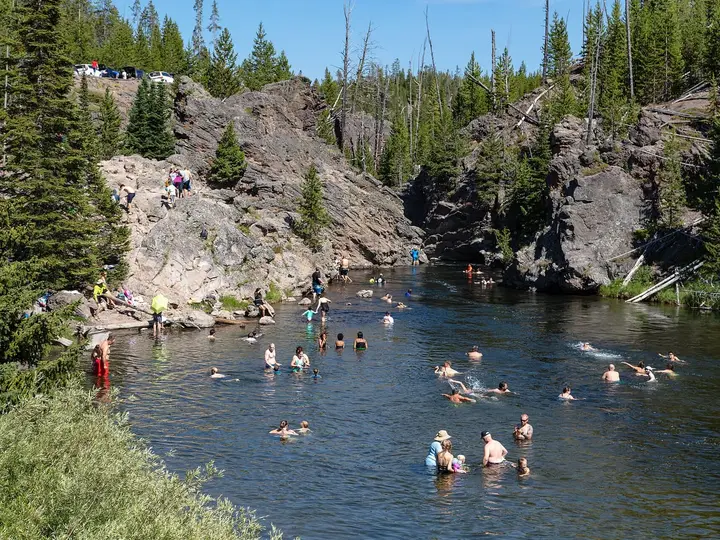
96-105°F36-41°C
Resort or spa
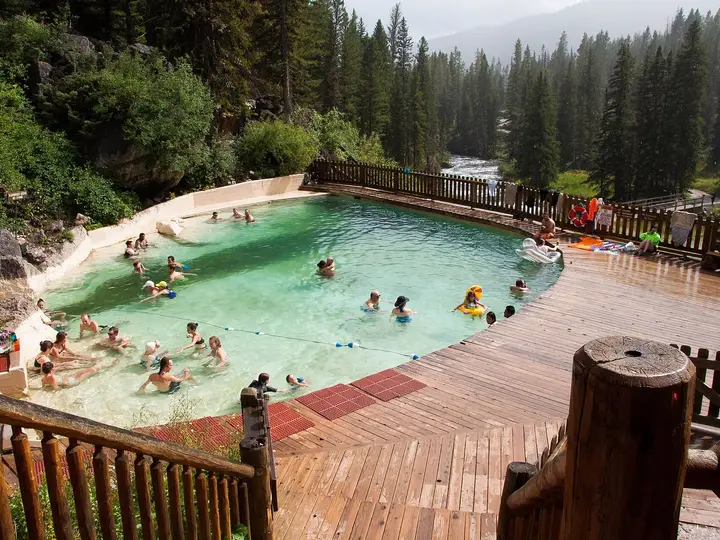
Granite Hot Springs Pool
Wyoming, United States
53 mi away, ~1.5 hr drive
95-112°F35-44°C Paid Drive-up
100-104°F38-40°C
Public pool
Astoria Hot Springs Park
Wyoming, United States
56 mi away, ~1.5 hr drive
100-104°F38-40°C Paid Drive-up
All hot springs in WyomingAll hot springs in United StatesOpen the full map