Borax Hot Springs
Near Fields, Oregon, United States
A hot, mineral-crusted lake and string of scalding spring pools in the Alvord Basin north of Fields, protected as a Nature Conservancy preserve. You can walk in to look, but not to soak.
Closed to the public. Not a soaking site. Borax Lake and the hot springs beside it are in a Nature Conservancy preserve where entering or disturbing the lake or springs is prohibited. The water carries arsenic and lead, and some springs are scalding. You can walk in to look.
Photo: Amateria1121 (CC BY-SA 3.0). Resized and cropped for this page.

- Water temperature
- Not published
- Entry
- Free
- Getting in
- Short walk
- Type
- Wild & natural
- The 10-acre lake sits on a raised mound of its own mineral deposits and is fed by hot springs about 100 feet below the surface.
- Springs under the lake range from about 104 to 300°F40 to 149°C, and testing shows high levels of arsenic, lead and borax.
- The Borax Lake chub, a small fish found nowhere else, lives in the warm outflow.
- Ruins of a borax works that shipped by mule team to Winnemucca still stand near the lake.
Current status: look, do not soak
Borax Hot Springs is the name some lists use for Borax Lake and the hot springs around it, in the Alvord Basin a few miles north of Fields. We treat this page as the guide to that whole site, because the lake and the springs share one access route, one owner and one set of rules.
It is not a soak. The Nature Conservancy owns the lake and asks every visitor not to enter or disturb the lake or the adjacent hot springs. The water is fed by very hot springs, and testing shows high levels of arsenic, lead and sodium borate. Those minerals are natural, but they are toxic to people. Some of the small pools around the lake are hot enough to cause serious burns.
You can still walk out and see it. It is one of the strangest places in Oregon, and an easy add-on to a trip to the Alvord Desert.
What to expect
Borax Lake covers about 10 acres and sits on a raised mound built up from its own mineral deposits, so it looks a little like a shallow bowl set on top of the desert floor. Hot springs feed it from about 100 feet down. Wikipedia reports that those springs range from roughly 104 to 300°F40 to 149°C, while the surface water usually runs 61-100°F16-38°C. The Nature Conservancy says the surface can reach 105°F41°C.
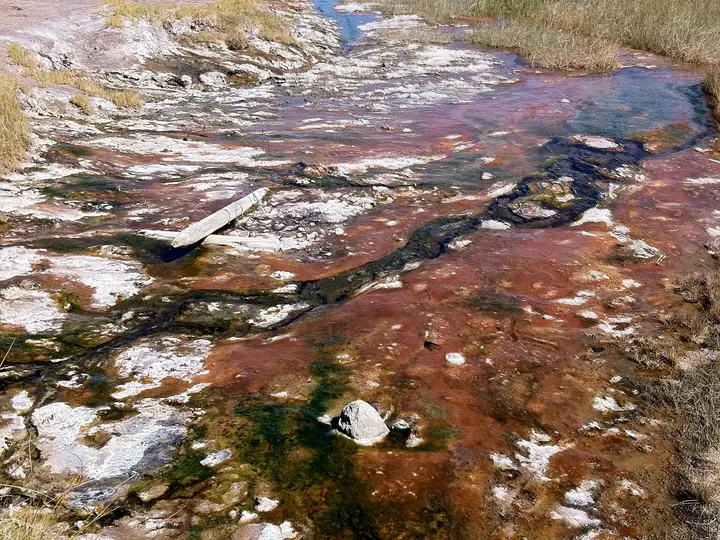
Around the lake are smaller hot pools and channels, crusted white with minerals and edged by thin, fragile ground. Hot Springs Locator warns that the crust beside some pools is thin enough to break and expose scalding water. Steam rises off them on cold mornings. There are no boardwalks, no toilets and no shade.
The lake is also the only home of the Borax Lake chub, a small minnow that has adapted to warm, mineral-heavy water. The U.S. Fish and Wildlife Service took it off the federal endangered list in July 2020, and Oregon removed it from the state list in February 2021, with federal monitoring planned for 10 years after delisting. That recovery is one reason the rules here are firm.
History
The springs were known as a borax source long before they became a preserve. Rose Valley Borax acquired the site in the late 1800s and mined it for about 10 years, with mule teams hauling the borax to the railroad at Winnemucca, Nevada. Mining stopped in 1902. You can still see the ruins of the old works near the lake.
The Nature Conservancy began working at the site in 1983 and bought the lake and about 160 acres of surrounding private land in 1993. It now manages the habitat with the U.S. Fish and Wildlife Service, the Bureau of Land Management and the Oregon Department of Fish and Wildlife. The Steens Mountain Cooperative Management and Protection Act of 2000 also closed the area around the lake to geothermal exploration and mining.
Getting there
Fields is a tiny community about 105 miles south of Burns on Highway 205, close to the Nevada line. The Nature Conservancy gives these directions:
- From Fields, head north toward Andrews. About 1.75 miles out, turn east onto a dirt track at the power substation on the right.
- Follow the track east beside the power line for 2 miles.
- Turn north and continue about 1 mile.
- Park along the road by the gate. Vehicles are not allowed on the preserve, except for visitors with disabilities and researchers.
- Walk northeast on the main track, past a lower reservoir, to the raised mound where the lake sits. A BLM fence crosses the road about half a mile southwest of the lake.
Hot Springs Locator describes two gates on this approach, with motor vehicles barred past the second one and a walk of about half a mile from there to the lake.
The track is dusty and rough in dry weather and dangerous when wet. The Conservancy says it is often impassable in winter, and the fine clay in this basin turns slick and sticky after rain. High clearance helps. If the ground is wet, stay on the pavement.
When to go
The preserve has no posted hours. Spring and fall are the most comfortable seasons, with mild days and a good chance of a dry road. Summer is very hot on the open desert floor, and the Conservancy warns that the region swings to extremes of heat and cold. Go early in the day in summer, carry plenty of water, and avoid the hottest afternoons. Winter can bring snow, freezing nights and an unusable road.
Rules and etiquette
The Nature Conservancy’s rules for the preserve:
- Do not enter or disturb the lake or the hot springs.
- No dogs. The preserve protects ground-nesting birds.
- No vehicles or bicycles on the preserve.
- Stay on the trail. Do not collect plants, insects or other animals, and do not disturb soil, rocks, artifacts or research markers.
- No hunting, fishing, camping or campfires.
- No drone takeoffs or landings on the preserve.
- Pack out your trash. Bring a bag.
- Groups of 10 or more should contact the Conservancy first at oregon@tnc.org or 503-802-8100.
Where to stay nearby
There is no camping on the preserve. Fields has a small station with food and fuel, but check its hours before relying on it. Alvord Hot Springs, about 23 miles north of Fields on the Fields-Denio Road, has campsites, bunkhouses and two soaking pools on a private ranch, and it is the obvious place to pair with a visit here. The BLM also allows free dispersed camping on the Alvord Desert playa in dry conditions, with no facilities. Burns has the nearest full range of motels and supplies.
Safety notes
- Scalding water: Some springs here are far above safe temperatures. Keep well back from pool edges.
- Thin crust: The mineral ground around the pools can give way. Stay on the track.
- Toxic water: Arsenic, lead and borax make the water unsafe to drink or bathe in. Do not let children touch it.
- Remoteness: Cell coverage is poor and help is far away. Carry extra water, food and a spare tire.
- Mud: A wet road can strand even four-wheel-drive vehicles. Turn back if it starts to rain.
Map and nearby springs
GPS: 42.32740, -118.60440
Borax Hot Springs: common questions
Can you swim or soak at Borax Lake or Borax Hot Springs?
No. The Nature Conservancy, which owns the lake, asks visitors not to enter or disturb the lake or the adjacent hot springs. The water has high levels of naturally occurring arsenic, lead and borax, and some of the springs are hot enough to scald.
How hot is Borax Lake?
Wikipedia reports springs under the lake from about 104 to 300°F40 to 149°C, with surface water usually 61-100°F16-38°C. The Nature Conservancy says the surface can reach 105°F41°C. The small pools beside the lake can be far hotter than the lake itself.
How do you get to Borax Lake?
From Fields, head north toward Andrews about 1.75 miles and turn east on a dirt track at the power substation. Follow the power line east for 2 miles, then turn north for about a mile and park by the gate. Walk northeast about half a mile to the lake. Vehicles are not allowed on the preserve.
Can you bring a dog to Borax Lake?
No. Dogs are not allowed on the preserve because it protects ground-nesting birds, and the hot water is a real danger to pets.
Where is the nearest hot spring you can soak in?
Alvord Hot Springs, on the Fields-Denio Road about 23 miles north of Fields, has two concrete soaking pools on a private ranch with camping and bunkhouses. It charges a fee and asks day visitors to call ahead.
Closest hot springs to Borax Hot Springs
100-104°F38-40°C
Wild & natural
Willow Creek Hot Springs (Whitehorse Ranch Hot Springs)
Oregon, United States
18 mi away, ~30 min drive
100-104°F38-40°C Free Drive-up
100-108°F38-42°C
Wild & natural
Near Frenchglen
Wild & natural
80-95°F27-35°C
Public pool
All hot springs in OregonAll hot springs in United StatesOpen the full map